Entramado de pertenencia
[Weave of Belonging]
-
Entramado de pertenencia (desde 1999)
Por medio de esta serie se investiga la vestimenta y el tejido como códigos visuales mediante los cuales una comunidad reconoce, incluye o distingue a sus miembros. El proyecto entrelaza la filiación elegida dentro de la subcultura punk con la herencia ancestral de la experiencia mestiza guatemalteca. Las camisetas, las insignias y los textiles tradicionales funcionan como archivos materiales dotados de color, técnica y sintaxis propia. El trabajo habita el espacio de confluencia entre ambos lenguajes, asumiendo la construcción identitaria desde la memoria fragmentada y el reconocimiento del origen mestizo.
-
Entramado de pertenencia [Weave of Belonging] (since 1999)
Through this series, clothing and weaving are examined as visual codes through which a community recognizes, includes, or distinguishes its members. The project intertwines chosen affiliation within the punk subculture with the ancestral inheritance of the Guatemalan mestizo experience.
T-shirts, insignias, and traditional textiles function as material archives endowed with their own color, technique, and syntax. The work inhabits the space where these two languages converge, approaching the construction of identity through fragmented memory and the recognition of mestizo origins.
Cartografía de la permanencia [Cartography of Permanence] (2026) Raw cotton, traditional Guatemalan textiles, household textile, paper, ink and acrylic. Collage and assemblage.
95 × 163 cm
Unique piece
La siembra -I- [The Sowing -I-] (2026) Cotton yarn woven on a traditional hand-operated treadle loom
114 × 133 cm
Unique piece
Design and artistic direction: Mod Cárdenas
Weaving produced in collaboration with Darío Eliezer Maldonado Unique piece
La siembra II [The Sowing II] (2026) Cotton yarn woven on a traditional hand-operated treadle loom
114 × 133 cm
Design and artistic direction by Mod Cárdenas
Woven in collaboration with Darío Eliezer Maldonado
Unique piece
-
La siembra constituye un desarrollo dentro de Entramado de pertenencia concebido y realizado en colaboración con el maestro tejedor Darío Eliezar Maldonado en telar de pedal manual con hilos de algodón. La composición visual y la estructura física del textil se producen de manera simultánea durante el proceso de tejido.
El proyecto plantea una reflexión profunda sobre el maíz, la siembra y el viaje, concibiendo el cultivo como una relación viva con la tierra, el sustento, el tiempo, el cuidado y la continuidad entre generaciones. Las imágenes se estructuran a través de trazos inscritos en la trama que se conectan, se interrumpen y cambian de trayectoria.
Estos recorridos traducen la vivencia de una memoria genealógica activa, postulando la pertenencia como un ejercicio del presente capaz de abrazar sus continuidades y sus desconexiones.
-
La siembra [The Sowing] is a development within Entramado de pertenencia [Weave of Belonging], conceived and produced in collaboration with master weaver Darío Eliezar Maldonado on a hand-operated treadle loom using cotton yarn. The visual composition and the physical structure of the textile are generated simultaneously during the weaving process.
The project sets out a sustained reflection on maize, sowing, and journeying, understanding cultivation as a living relationship with the land, sustenance, time, care, and continuity between generations. The images are structured through marks inscribed in the weft that connect, break off, and change direction.
These trajectories translate the lived experience of an active genealogical memory, proposing belonging as an exercise of the present, capable of embracing both its continuities and its disconnections.
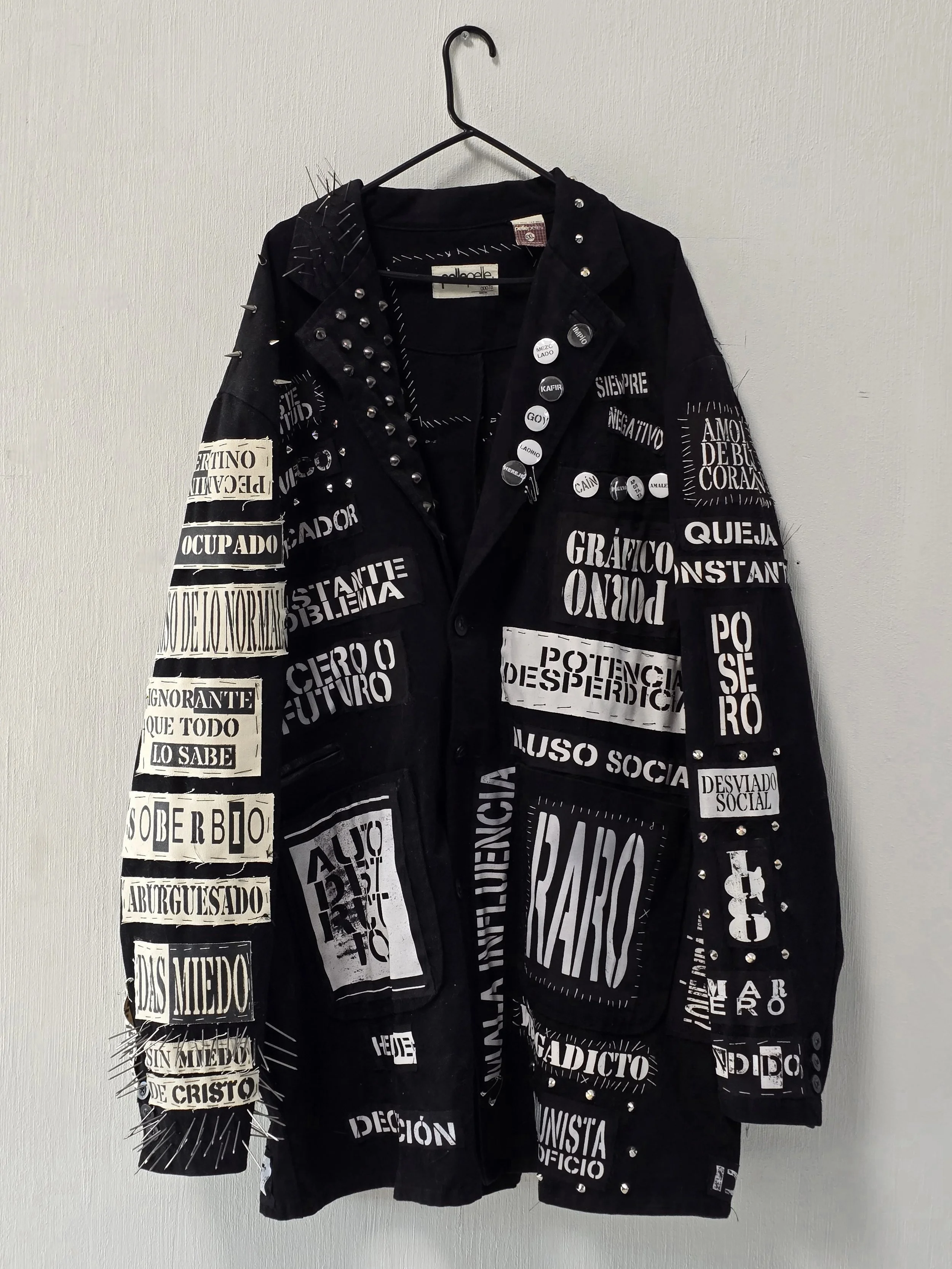
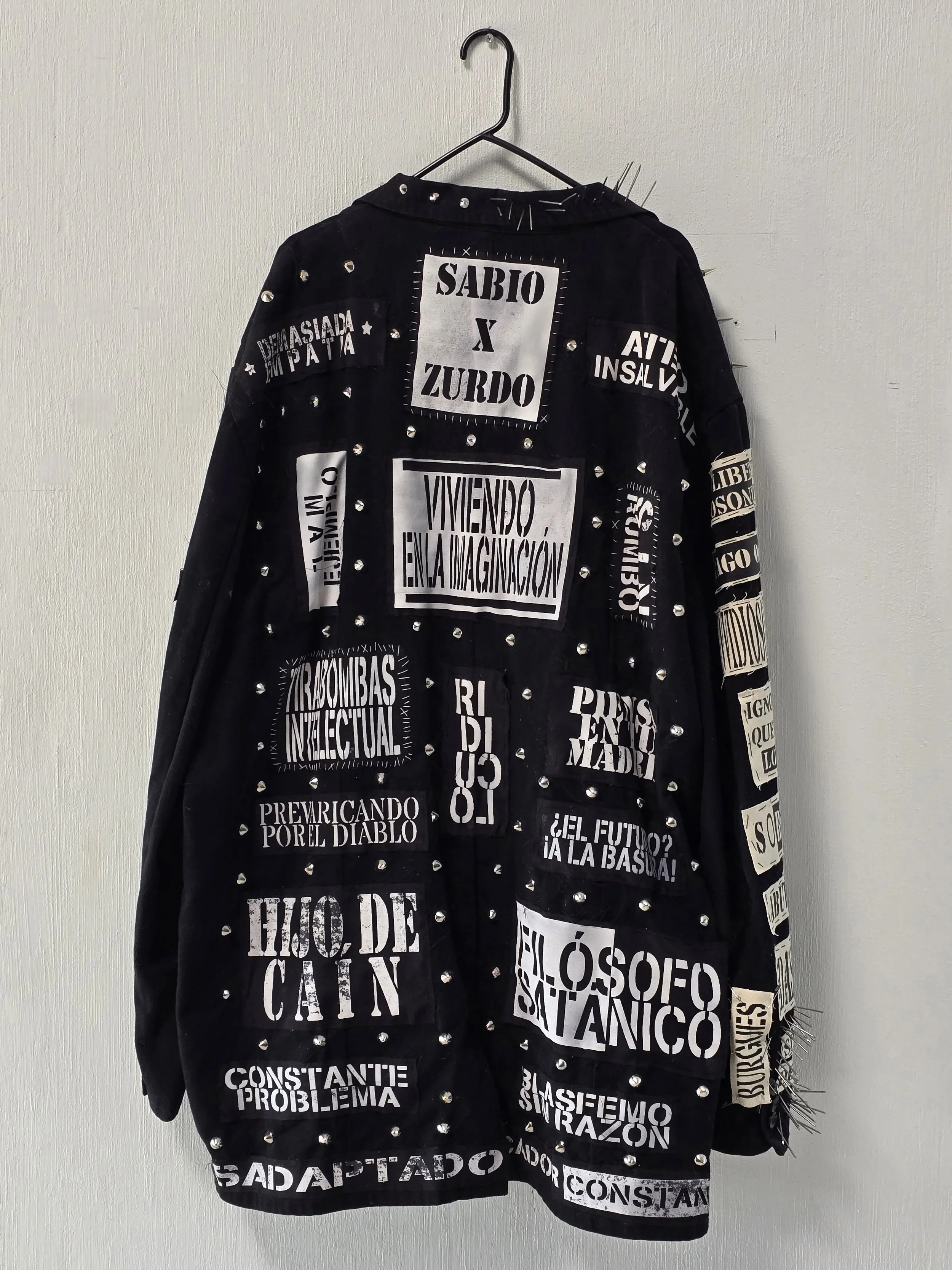
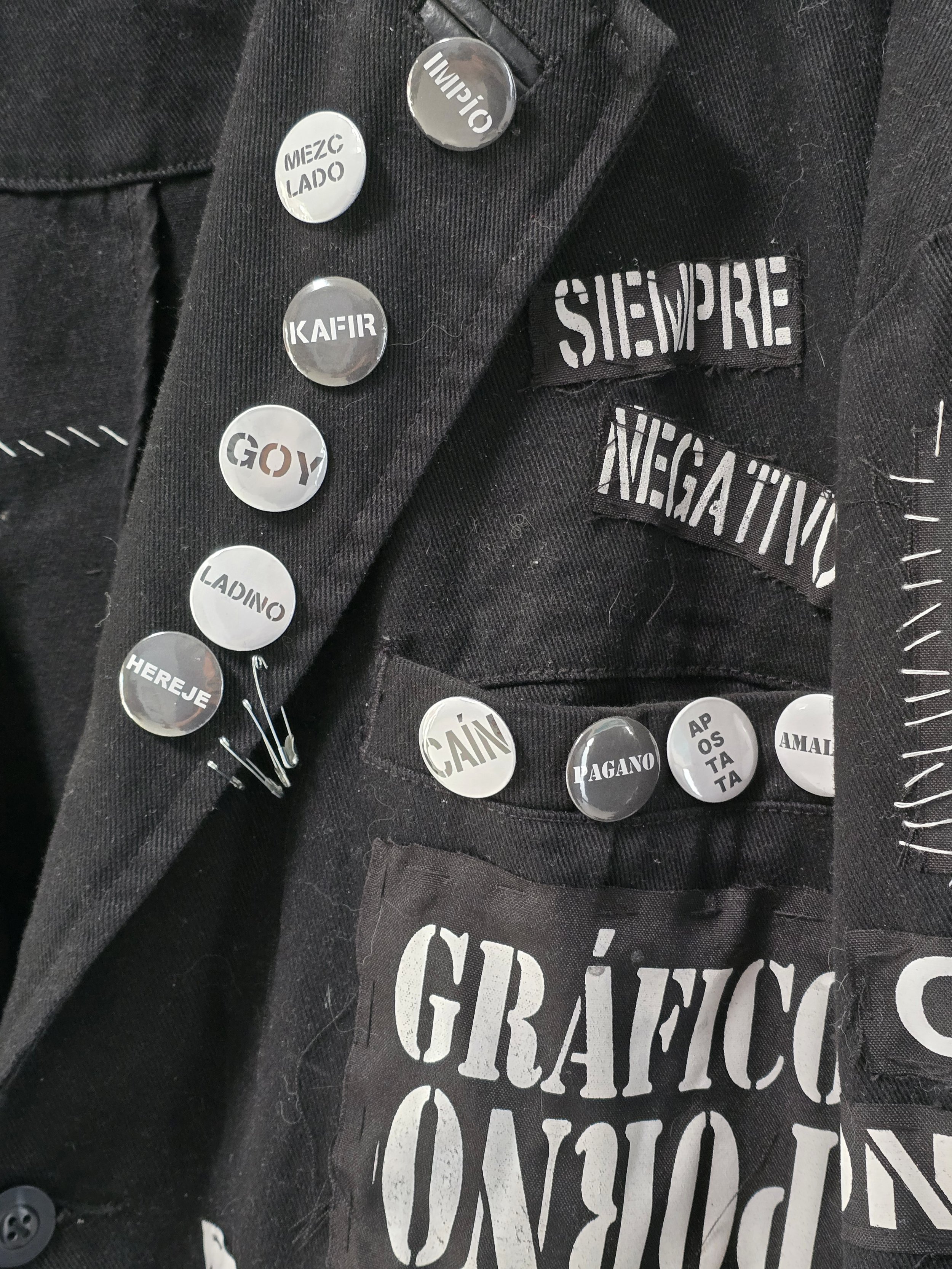
Archivo (c. 1999–2000) Tres chaquetas punk intervenidas con parches, pines, texto, taches y elementos metálicos
Dimensiones variables
Serie de tres piezas, una conservada y dos perdidas
-
Archivo (c. 1999–2000)
La serie está compuesta por tres chaquetas punk realizadas y utilizadas por Cárdenas durante su adolescencia. Sobre ellas incorporó parches, pines, taches y palabras recibidas en distintos espacios familiares, religiosos, escolares y sociales. Expresiones como hijo de Caín, zurdo, filósofo satánico, problema social, infiel y ateo quedaron incorporadas directamente a las prendas.
Las chaquetas convierten el cuerpo en un lugar donde coinciden dos sistemas de identificación. Por un lado, conservan los términos utilizados desde afuera para señalar, corregir o excluir. Por otro, reúnen los signos de una pertenencia elegida dentro de la cultura punk. Música, insignias, materiales y modificaciones construyen un lenguaje mediante el cual el cuerpo puede reconocerse frente a otros y decidir cómo mostrarse.
Los taches y elementos metálicos amplían esta función. Además de participar del código visual punk, modifican físicamente la relación entre el cuerpo y su entorno, introduciendo distancia y protección dentro de la propia vestimenta.
Dos de las tres chaquetas se perdieron y solamente una permanece. Archivo existe así como un conjunto incompleto en el que la ausencia de las otras piezas forma parte de la obra. La prenda conservada no reconstruye aquella experiencia, sino que permanece como uno de los objetos que participaron directamente en ella.
Dentro de Entramado de pertenencia, la serie marca un punto temprano en la investigación de Cárdenas sobre la vestimenta como espacio donde se cruzan identidad, pertenencia, defensa y memoria.
-
Archive (c. 1999–2000)
The series consists of three punk jackets made and worn by Cárdenas during his adolescence. Their surfaces accumulated patches, pins, studs, and words directed at him within family, religious, educational, and social settings. Terms including son of Cain, leftist, satanic philosopher, social problem, infidel, and atheist became part of the garments themselves.
The jackets bring two systems of identification onto the same body. They retain language imposed from the outside while also carrying the signs of a chosen affiliation within punk culture. Music, insignia, materials, and alterations form a visual language through which the wearer could recognize others, be recognized, and determine how he appeared in public.
The studs and metal elements extend this function beyond identification. As part of the punk visual code, they also alter the physical relationship between the body and its surroundings, introducing distance and protection into the garment itself.
Two of the three jackets were lost, leaving only one surviving piece. Archive therefore exists as an incomplete group in which absence has become part of the work. The remaining jacket does not reconstruct the period retrospectively. It is one of the objects that moved through that experience with the body.
Within Weave of Belonging, the series marks an early stage in Cárdenas’s investigation of clothing as a site where identity, belonging, protection, and memory intersect.