2010 - 2012.
Camisetas punk, textiles tradicionales guatemaltecos y bastidores de madera
Serie / dimensiones variables
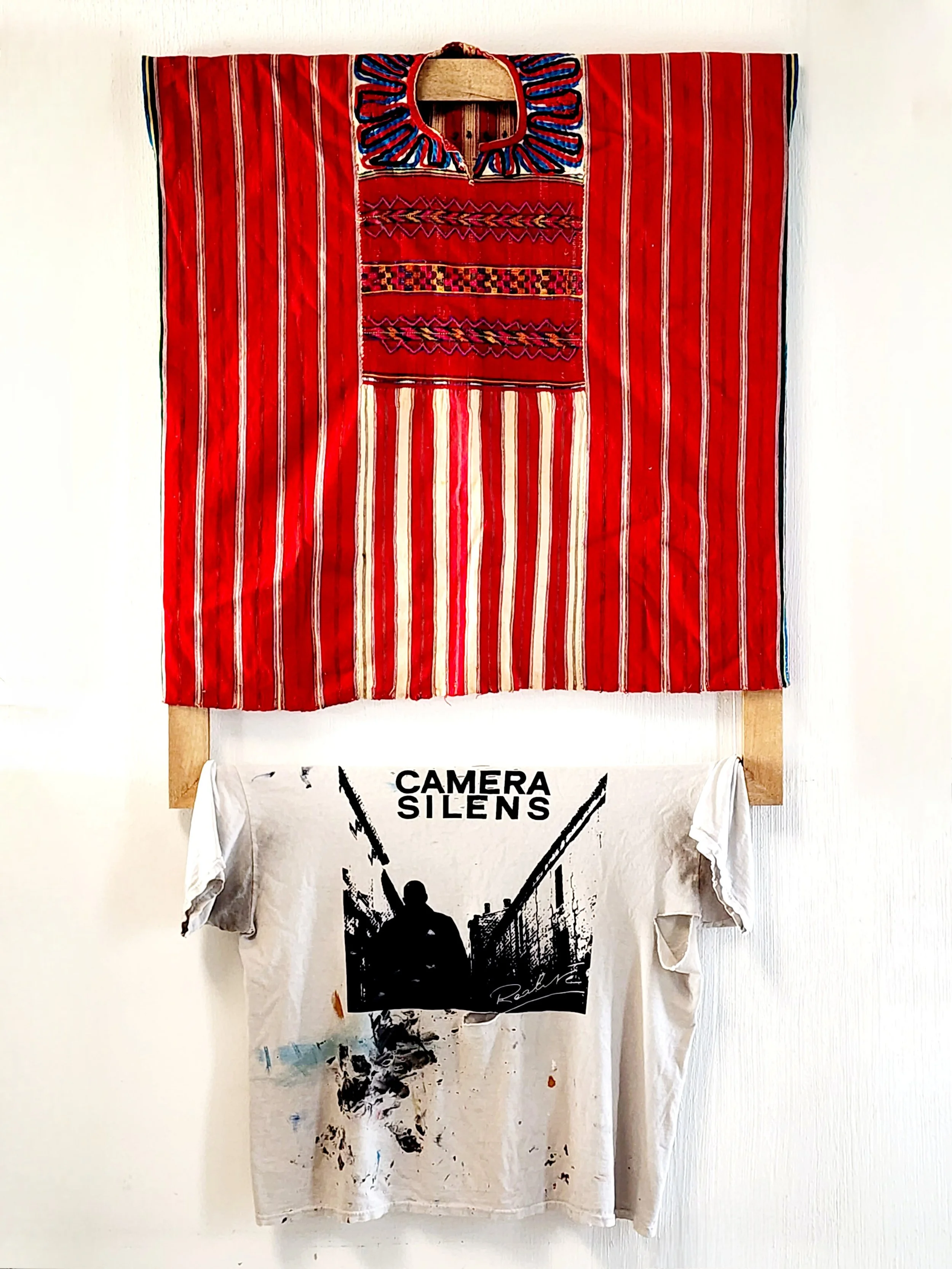
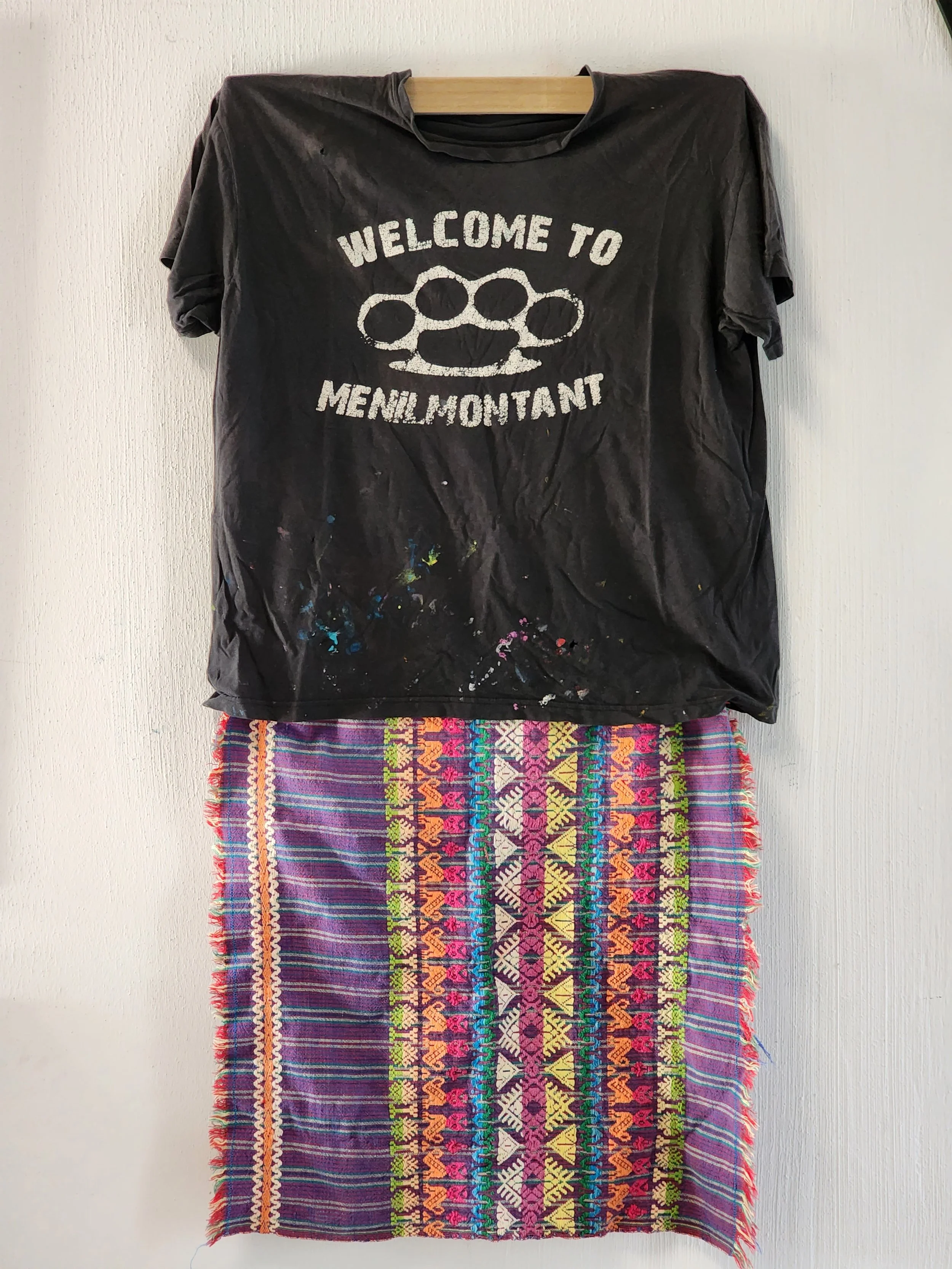
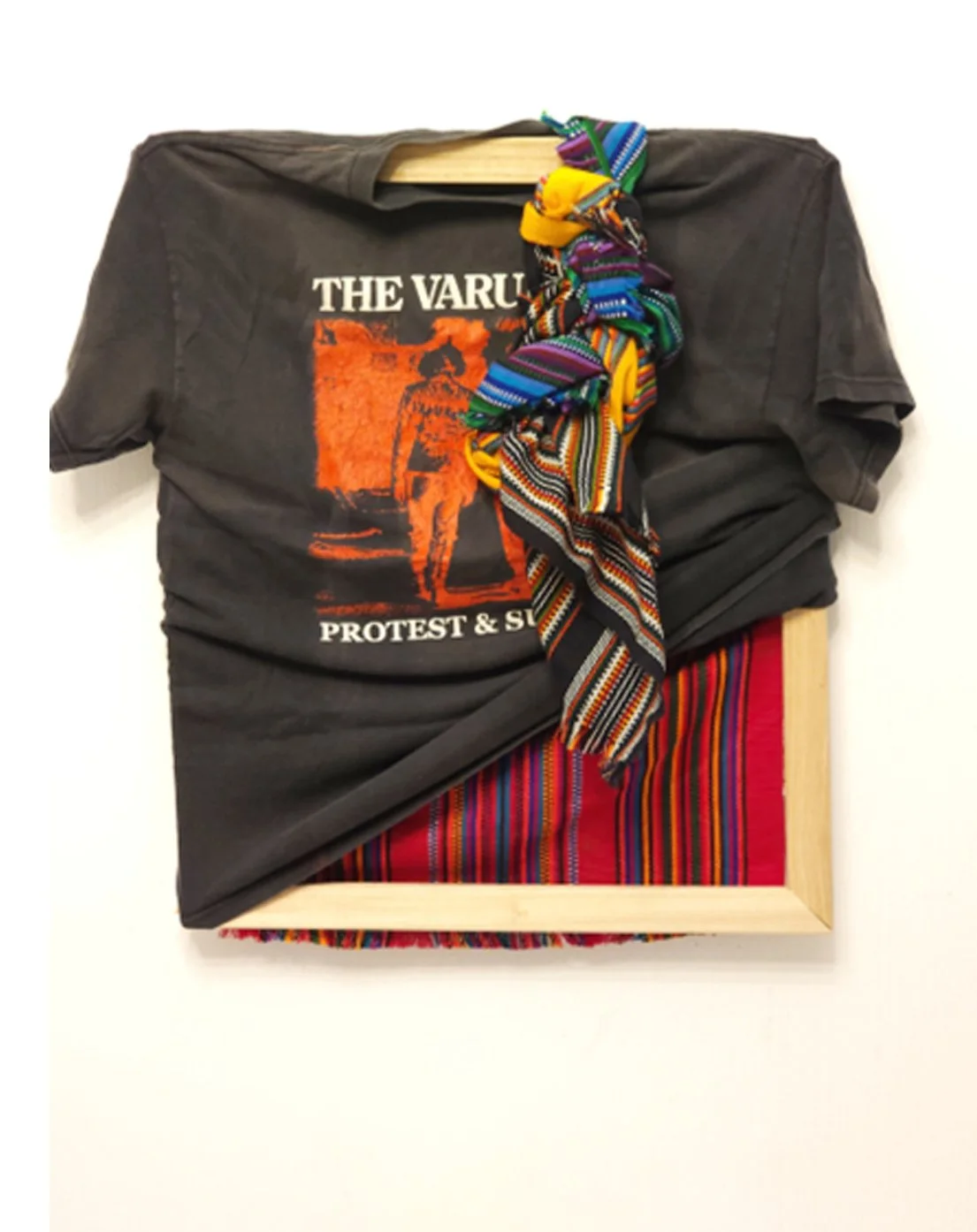
Entramado de pertenencia reúne una serie de ensamblajes textiles construidos a partir de camisetas punk y tejidos tradicionales guatemaltecos. En estas obras, el bastidor de pintura conserva su estructura, pero el lienzo es sustituido por vestimentas y textiles cargados de uso, memoria y afiliación. La imagen no se pinta: se arma con materiales que ya han vestido cuerpos, comunidades e historias.
La serie parte de dos formas distintas de pertenencia. La camiseta punk remite a una comunidad elegida voluntariamente: una red urbana, subcultural y afectiva ligada al hazlo tú mismo, la música, la calle, la resistencia y la construcción de comunidad desde la periferia. Los textiles tradicionales guatemaltecos, en cambio, aparecen como una raíz ancestral fragmentada. No los utilizo para reclamar una identidad indígena directa, sino para señalar una historia que me atraviesa precisamente como ausencia. Como mestizo, conozco parte de mi ascendencia europea, pero mis raíces indígenas fueron borradas, desordenadas o silenciadas por la historia familiar, colonial y social.
Ambos textiles operan como signos de identificación. Para quien conoce sus códigos, una camiseta punk puede señalar pertenencia a una escena, una ética o una comunidad afectiva; del mismo modo, un textil tradicional puede remitir a territorio, linaje, oficio, memoria colectiva o continuidad cultural. En ambos casos, la vestimenta no solo cubre el cuerpo: lo inscribe dentro de una red de lectura. Permite ser reconocido por otros, pero también clasificado, aceptado, rechazado o situado.
Al unir ambos registros, la obra no opone tradición y contracultura, sino que observa cómo la pertenencia puede ser elegida, heredada, perdida o inventada desde sus restos. Las camisetas y los textiles funcionan como archivos materiales: documentos de comunidad, cuerpo, deseo, pérdida y lectura social. Dentro de mi práctica, estas piezas se relacionan con las máquinas heredadas que forman el cuerpo: sistemas de signos, telas, colores, símbolos y silencios que nos enseñan cómo pertenecer, cómo ser leídos y qué partes de nuestra historia llegan hasta nosotros como relato, y cuáles solo sobreviven como vacío.
ENG.
Woven Belonging
2010 - 2012.
Punk T-shirts, traditional Guatemalan textiles, and wooden stretchers
Series / variable dimensions
Woven Belonging brings together a series of textile assemblages made from punk T-shirts and traditional Guatemalan woven textiles. In these works, the painting stretcher remains, but the canvas is replaced by garments and fabrics charged with use, memory, and affiliation. The image is not painted; it is constructed from materials that have already dressed bodies, communities, and histories.
The series begins with two different forms of belonging. The punk T-shirt refers to a community I chose voluntarily: an urban, subcultural, and affective network shaped by DIY ethics, music, the street, resistance, and the construction of community from the margins. The traditional Guatemalan textiles, by contrast, appear as a fragmented ancestral root. I do not use them to claim a direct Indigenous identity, but to point toward a history that runs through me precisely as absence. As a mestizo person, I know part of my European ancestry, while my Indigenous roots have been erased, disordered, or silenced by family, colonial, and social history.
Both textiles operate as signs of identification. For those who know their codes, a punk T-shirt can signal belonging to a scene, an ethic, or an affective community; in the same way, a traditional textile can refer to territory, lineage, craft, collective memory, or cultural continuity. In both cases, clothing does not only cover the body: it inscribes it within a network of reading. It allows the wearer to be recognized by others, but also classified, accepted, rejected, or situated.
By bringing these two registers together, the work does not oppose tradition and counterculture. Instead, it observes how belonging can be chosen, inherited, lost, or reconstructed from what remains. The T-shirts and textiles function as material archives: documents of community, body, desire, loss, and social legibility. Within my practice, these works relate to the inherited machines that shape the body: systems of signs, fabrics, colors, symbols, and silences that teach us how to belong, how to be read, and which parts of our history reach us as narrative, while others survive only as absence.
Entramado de pertenencia
Serie de tres chaquetas, c. 1999–2000
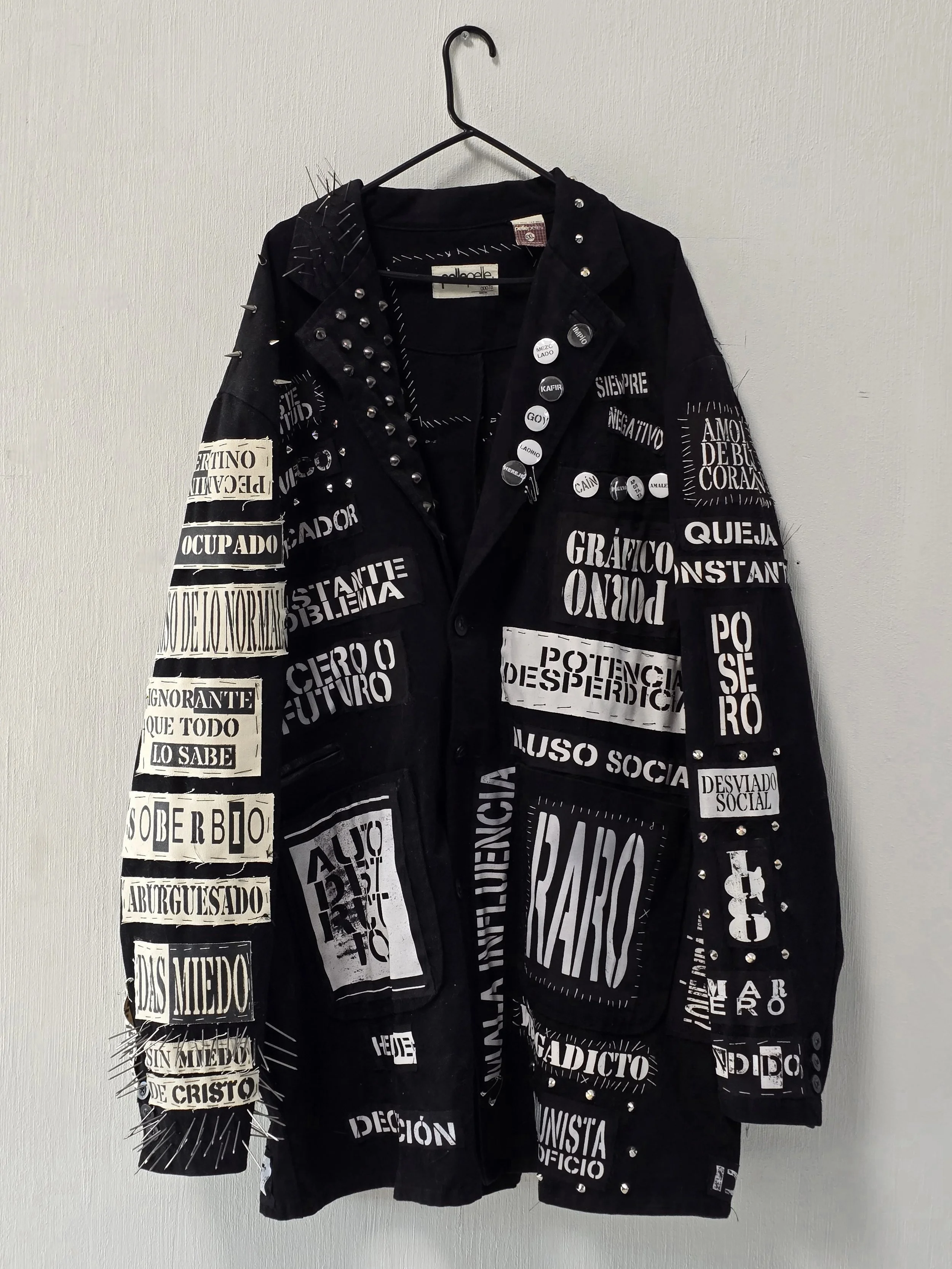
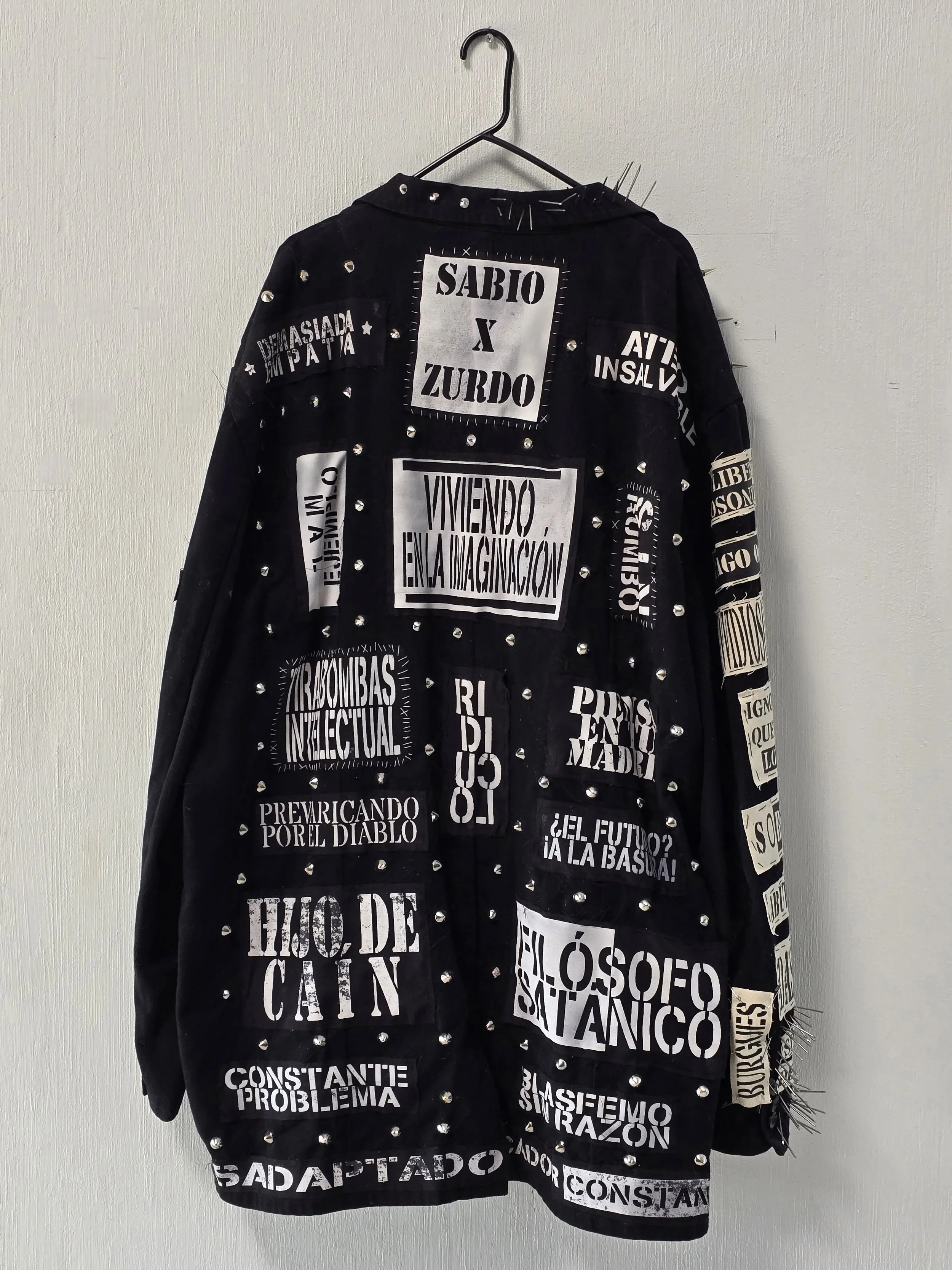
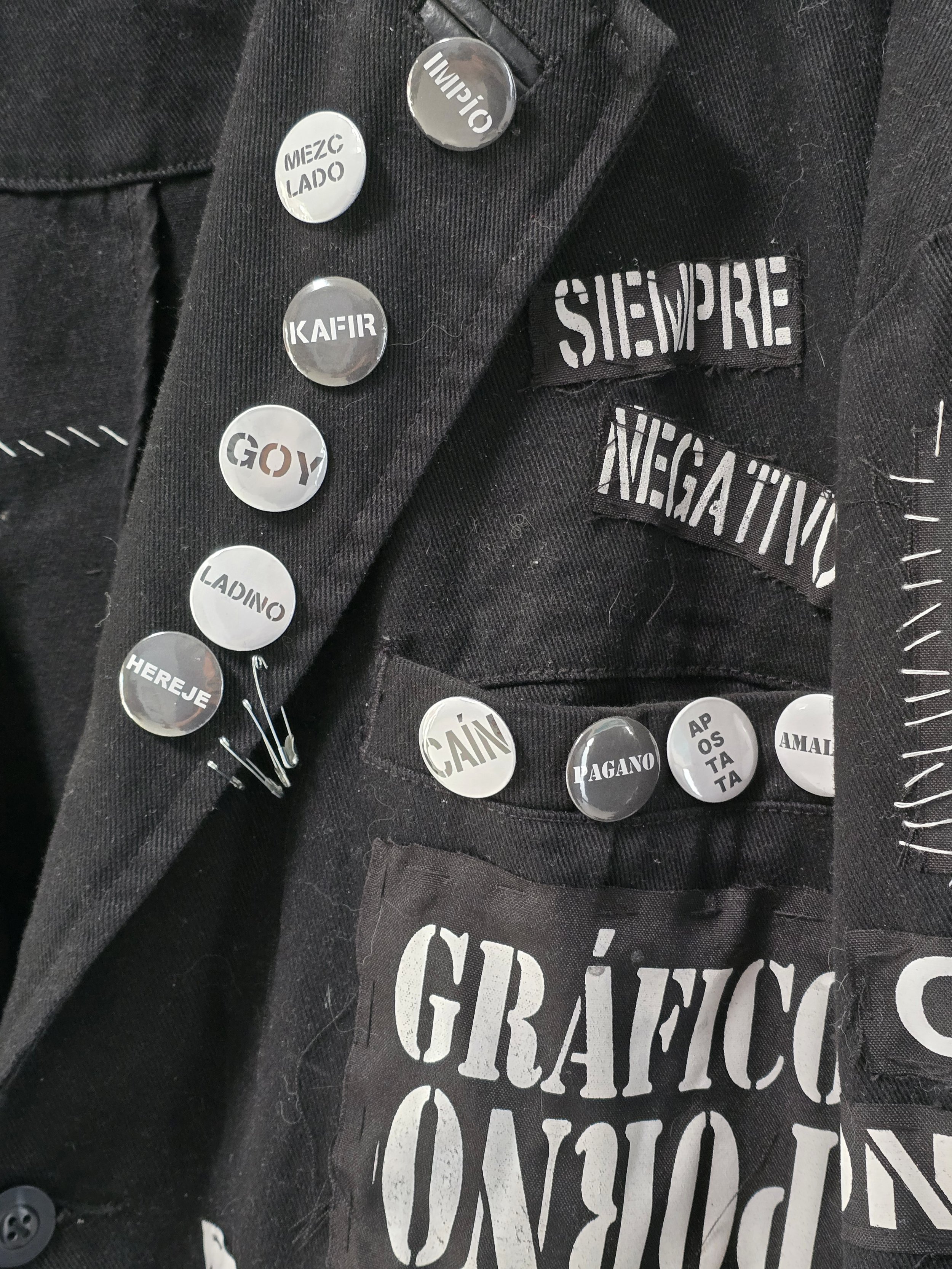
Realicé y utilicé estas tres chaquetas punk durante mi adolescencia, cuando tenía aproximadamente diecisiete o dieciocho años. Sobre sus superficies incorporé parches, pines, taches y palabras con las que distintas personas e instituciones intentaban definirme. Entre ellas aparecían “hijo de Caín”, “zurdo”, “filósofo satánico”, “problema social”, “infiel” y “ateo”: denominaciones provenientes de entornos familiares, religiosos, escolares y sociales, formuladas como acusación, advertencia o corrección.
La serie funciona simultáneamente como vestimenta, superficie de inscripción y archivo. No reconstruye retrospectivamente aquella experiencia: las chaquetas fueron producidas y llevadas mientras esos procesos estaban ocurriendo. Las palabras, los materiales, las modificaciones y las marcas de uso registraban un momento específico de mi vida. El archivo no se encontraba separado del cuerpo, sino construido sobre prendas que me acompañaban, me identificaban y condicionaban la manera en que otros se relacionaban conmigo.
Al convertir los insultos en parches visibles, trasladé esas palabras desde los espacios privados donde habían sido pronunciadas hacia la superficie pública de mi cuerpo. No intenté borrarlas ni transformarlas en afirmaciones positivas. Conservé su violencia, pero modifiqué su circulación y el lugar desde el cual podían ser leídas. Aquello que pretendía fijar mi identidad desde afuera pasó a formar parte de una composición organizada y mostrada por mí.
Las chaquetas reunían dos formas de archivo. Por un lado, conservaban las categorías mediante las cuales la familia, la religión, el colegio y el entorno social intentaron clasificarme o excluirme. Por otro, incorporaban los códigos de una pertenencia elegida: música, vestimenta, insignias y signos mediante los cuales quienes compartíamos la cultura punk podíamos reconocernos. La serie mantenía juntas la memoria de la exclusión y la construcción de una comunidad propia.
Los taches y elementos metálicos no funcionaban únicamente como ornamento subcultural. En el contexto de la calle durante los años noventa, también operaban como advertencia y forma de protección corporal. La misma superficie que permitía ser reconocido por quienes comprendían sus códigos podía producir distancia frente a quienes representaban una amenaza. Identidad, defensa y pertenencia ocupaban una misma prenda.
De las tres chaquetas, dos se perdieron y solo una permanece. La serie funciona hoy como un archivo incompleto: la pieza conservada no representa la totalidad, sino que actúa como fragmento material de una experiencia más amplia. La ausencia de las otras dos no elimina su existencia; señala la fragilidad de los objetos que acompañan una vida y la imposibilidad de conservar íntegramente aquello que participó en la formación de una identidad.
Dentro de Entramado de pertenencia, la serie constituye un antecedente fundamental de mi investigación sobre la vestimenta como código de reconocimiento y archivo material. Las chaquetas conservaron tanto los nombres que me fueron asignados como los signos mediante los cuales elegí presentarme ante otros. No proponían una identidad resuelta: mantenían visibles la violencia de las palabras recibidas, la necesidad de protegerse y la búsqueda de una pertenencia construida desde el margen.
Materiales: tres chaquetas punk intervenidas con parches, pines, texto, taches y elementos metálicos
Dimensiones: pendientes
Estado de la serie: una chaqueta conservada y dos perdidas
Serie de tres objetos intervenidos
ENG.
UNTITLED
Series of three jackets, c. 1999–2000
I made and wore these three punk jackets during my adolescence, when I was approximately seventeen or eighteen years old. Across their surfaces, I incorporated patches, pins, studs, and words that different people and institutions had used in attempts to define me. These included “son of Cain,” “leftist,” “satanic philosopher,” “social problem,” “infidel,” and “atheist”: labels drawn from family, religious, educational, and social environments and expressed as accusations, warnings, or forms of correction.
The series functions simultaneously as clothing, a surface of inscription, and an archive. It does not retrospectively reconstruct that experience: the jackets were made and worn while those processes were taking place. Their words, materials, alterations, and traces of use recorded a specific period in my life. The archive was not separate from the body, but constructed upon garments that accompanied me, identified me, and shaped the ways in which others related to me.
By turning the insults into visible patches, I transferred those words from the private spaces in which they had been spoken onto the public surface of my body. I did not attempt to erase them or transform them into positive affirmations. I preserved their violence while altering their circulation and the position from which they could be read. What had attempted to define my identity from the outside became part of a composition organized and displayed by me.
The jackets brought together two forms of archive. On one hand, they preserved the categories through which family, religion, school, and the wider social environment attempted to classify or exclude me. On the other, they incorporated the codes of a chosen belonging: music, clothing, insignia, and signs through which those of us who shared punk culture could recognize one another. The series held together the memory of exclusion and the construction of a community of my own.
The studs and metal elements did not function solely as subcultural ornament. Within the context of the street during the 1990s, they also operated as a warning and a form of bodily protection. The same surface that allowed recognition among those who understood its codes could create distance from those who represented a threat. Identity, defense, and belonging occupied the same garment.
Of the three jackets, two were lost and only one remains. The series now functions as an incomplete archive: the surviving piece does not represent the whole, but acts as a material fragment of a broader experience. The absence of the other two does not erase their existence; it points to the fragility of the objects that accompany a life and to the impossibility of fully preserving everything that participated in the formation of an identity.
Within Entanglement of Belonging, the series constitutes a fundamental precedent for my investigation into clothing as a code of recognition and a material archive. The jackets preserved both the names assigned to me and the signs through which I chose to present myself to others. They did not propose a resolved identity; they kept visible the violence of the words I received, the need for protection, and the search for a form of belonging constructed from the margins.
Materials: three punk jackets altered with patches, pins, text, studs, and metal elements
Dimensions: pending
Current condition: one jacket preserved and two lost
Series of three altered objects
Sin título - Archivo
LA SIEMBRA
Serie, 2025
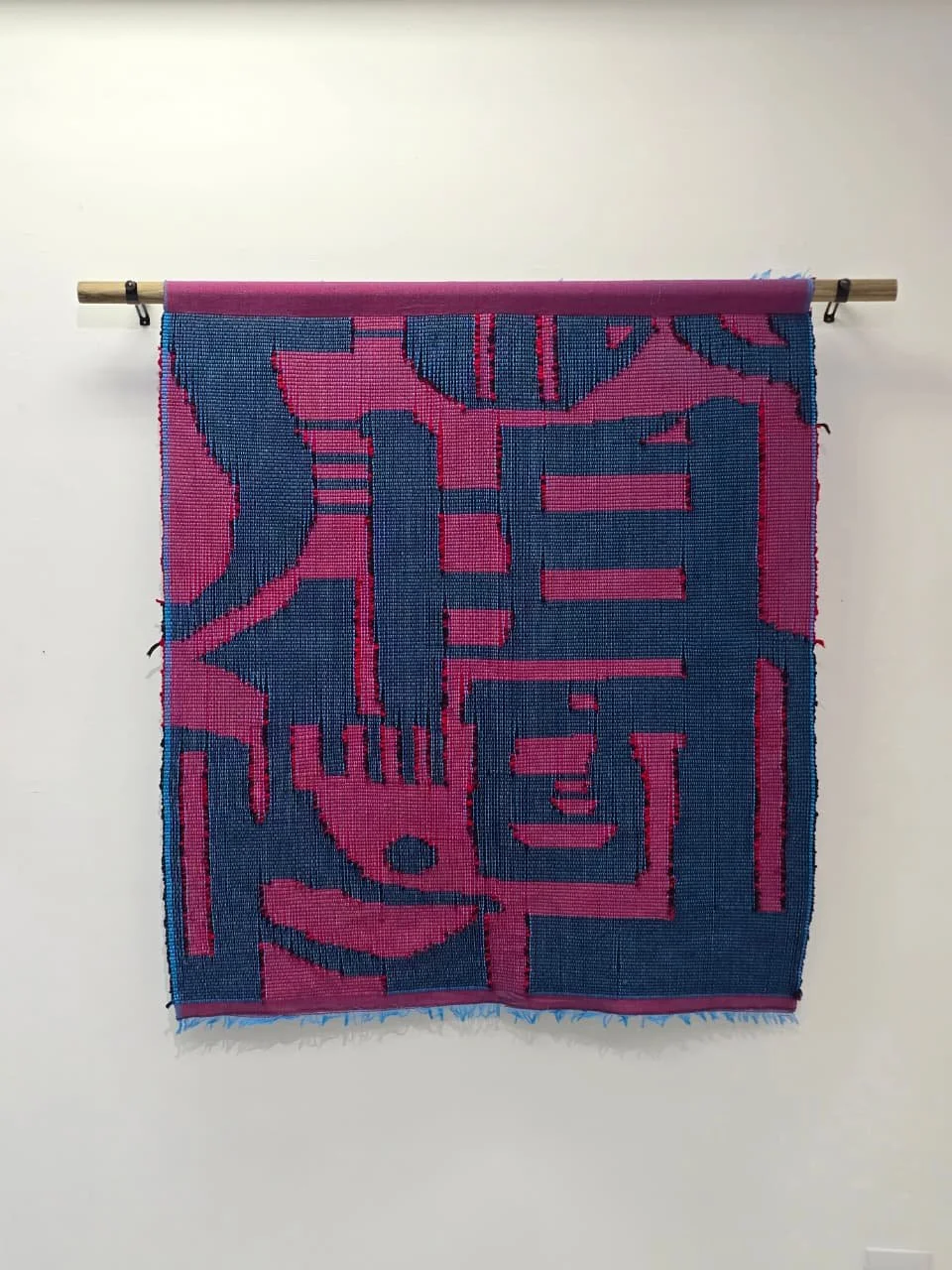
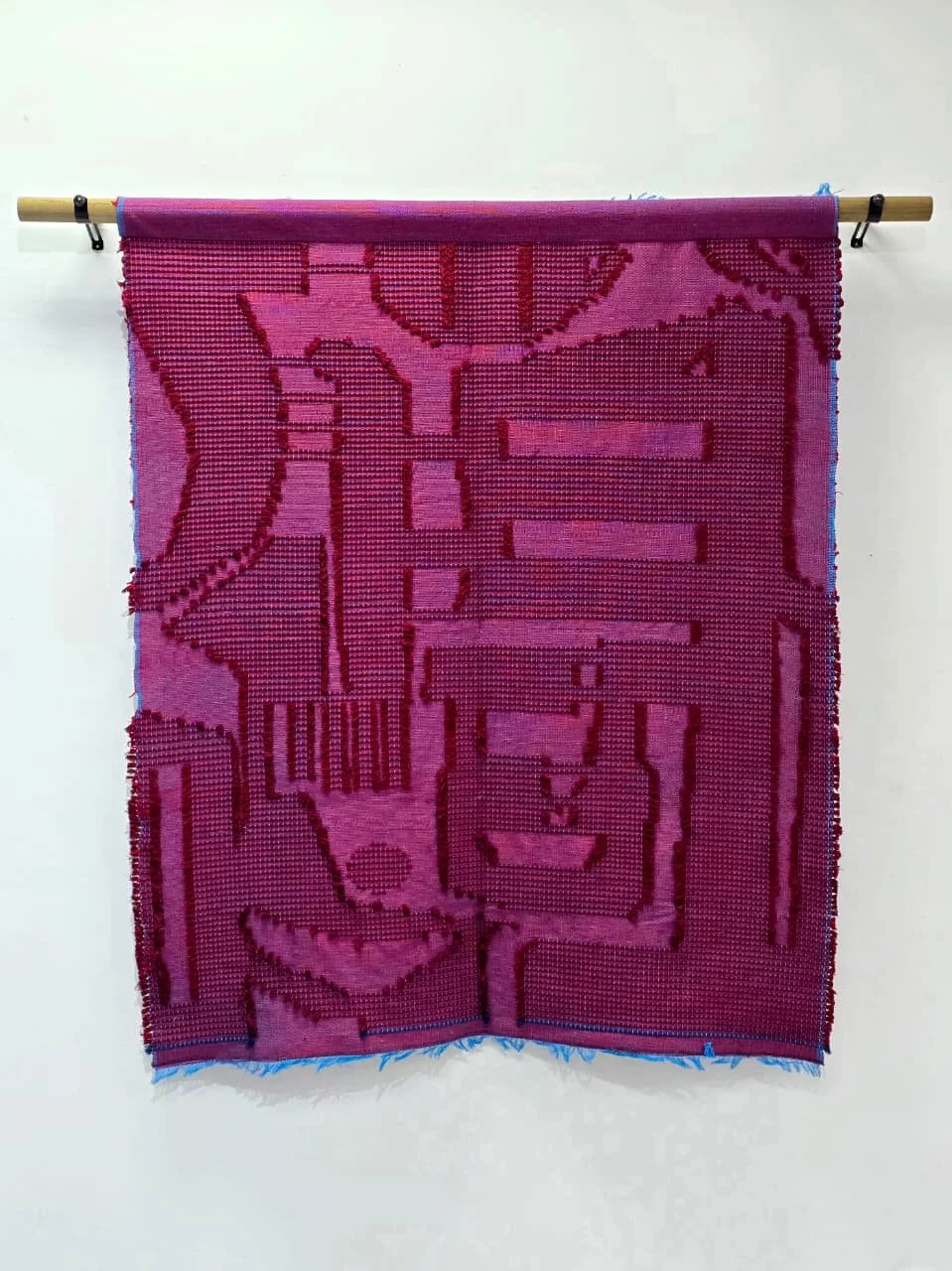
Estas obras fueron desarrolladas en colaboración con un tejedor experto, utilizando hilos de algodón trabajados en un telar de pedal manual tradicional. Las composiciones parten de dibujos y recorridos que concebí y que, durante el proceso de tejido, debieron traducirse a una estructura material de cruces, tensiones, continuidades e interrupciones. La colaboración no funciona como una etapa posterior de ejecución: forma parte de la construcción conceptual y material de cada pieza.
Me interesa que la geometría no aparezca aplicada sobre una superficie textil ya terminada. La imagen y el tejido se producen simultáneamente. Cada cambio de color, densidad, dirección o textura depende de la manera en que los hilos se encuentran, se separan y vuelven a relacionarse. Conectar y desconectar dejan de ser únicamente temas representados en la composición; son operaciones inscritas en la estructura misma de la obra.
La serie surge de una reflexión sobre el maíz, la siembra y el recorrido. No utilizo el maíz como un emblema decorativo ni como una afirmación simplificada de identidad. Me interesa como una estructura de relación con la tierra, el sustento, el tiempo, el cuidado y la continuidad entre generaciones. Sembrar implica preparar un territorio, abrir surcos, distribuir, esperar y aceptar que no todo lo plantado permanece o llega a crecer. Esa lógica aparece en las composiciones mediante trayectos que avanzan, se interrumpen, cambian de dirección o vuelven a encontrarse.
El telar introduce una temporalidad basada en la repetición y la acumulación. La imagen no aparece de una sola vez: se construye línea por línea, mediante decisiones que dependen tanto del diseño como del conocimiento técnico necesario para sostener la trama. El proceso exige negociar continuamente entre la forma imaginada y aquello que la estructura del tejido permite realizar. La obra emerge de ese encuentro entre mi lenguaje geométrico y una práctica material que posee sus propios ritmos, límites y formas de conocimiento.
Dentro de Entramado de pertenencia, estas piezas se relacionan con mi experiencia de una memoria genealógica desigual. Algunas partes de mi ascendencia pueden ser reconocidas; otras permanecen fragmentadas o inaccesibles. No intento utilizar el tejido como prueba de una identidad ancestral resuelta ni presentarme como depositario de una tradición a la que no tengo acceso completo. Trabajo desde esa distancia y desde la necesidad de reconocer tanto el vínculo como los vacíos que lo atraviesan.
Los recorridos de las composiciones traducen esa condición. En algunos momentos, las formas parecen establecer continuidad; en otros, se detienen, se separan o dejan zonas sin resolver. Conectarse no significa recuperar intacta una totalidad perdida, sino construir una relación desde el presente: avanzar dentro de una trama, encontrar continuidades parciales y reconocer aquello que permanece interrumpido.
La pertenencia aparece así como una práctica y no como una condición estable. Se construye mediante encuentros, transmisiones, cortes y nuevas relaciones. Estas obras no buscan cerrar los vacíos de una memoria incompleta, sino mantenerlos visibles mientras intentan producir, desde ellos, otra posibilidad de vínculo.
Materiales y técnica: hilos de algodón tejidos en telar de pedal manual tradicional
Diseño y dirección artística: Mod Cárdenas
Tejido realizado en colaboración con: tejedor experto; nombre por confirmar
Dimensiones: pendientes
Piezas únicas
ENG.
THE SOWING
Series, 2025
These works were developed in collaboration with an expert weaver using cotton threads woven on a traditional manual treadle loom. The compositions begin with drawings and pathways that I conceived and that, during the weaving process, had to be translated into a material structure of crossings, tensions, continuities, and interruptions. The collaboration does not function as a later stage of execution; it forms part of the conceptual and material construction of each work.
I am interested in preventing geometry from appearing as something applied to an already completed textile surface. The image and the fabric are produced simultaneously. Every change in color, density, direction, or texture depends on how the threads meet, separate, and enter into relation again. Connection and disconnection cease to be merely subjects represented within the composition; they become operations inscribed in the structure of the work itself.
The series emerges from a reflection on corn, sowing, and movement through space. I do not use corn as a decorative emblem or as a simplified affirmation of identity. I approach it as a structure of relation to land, sustenance, time, care, and continuity between generations. Sowing involves preparing a territory, opening furrows, distributing, waiting, and accepting that not everything planted will remain or grow. This logic appears in the compositions through paths that advance, become interrupted, change direction, or meet again.
The loom introduces a temporality based on repetition and accumulation. The image does not appear all at once; it is constructed line by line through decisions that depend both on the design and on the technical knowledge required to sustain the weave. The process demands continuous negotiation between the imagined form and what the structure of the textile allows to be made. The work emerges from this encounter between my geometric language and a material practice with its own rhythms, limitations, and forms of knowledge.
Within Entanglement of Belonging, these works relate to my experience of an uneven genealogical memory. Some parts of my ancestry can be identified, while others remain fragmented or inaccessible. I do not attempt to use weaving as proof of a resolved ancestral identity or to present myself as the bearer of a tradition to which I do not have complete access. I work from within this distance and from the need to acknowledge both the connection and the gaps that run through it.
The pathways within the compositions translate this condition. At certain moments, the forms appear to establish continuity; at others, they stop, separate, or leave areas unresolved. Connection does not mean recovering an intact, lost totality, but constructing a relationship from the present: moving through a weave, finding partial continuities, and recognizing what remains interrupted.
Belonging therefore appears as a practice rather than a stable condition. It is constructed through encounters, transmissions, cuts, and new relationships. These works do not attempt to close the gaps within an incomplete memory, but to keep them visible while producing, from within them, another possibility of connection.
Materials and technique: cotton threads woven on a traditional manual treadle loom
Design and artistic direction: Mod Cárdenas
Weaving produced in collaboration with: expert weaver; name to be confirmed
Dimensions: pending
Unique works