Máquinas heredadas investiga las estructuras sociales que asignan funciones, límites y posibilidades antes de que una persona pueda elegirlas. La máquina no aparece necesariamente como un aparato visible, sino como un sistema que organiza de manera jerarquizada el trabajo, la educación, la movilidad y el derecho a imaginar otro futuro.
El proyecto parte de contextos donde la infancia entra tempranamente en contacto con la necesidad, la disciplina y la supervivencia. Objetos vinculados al trabajo, uniformes, herramientas y sistemas de clasificación dejan de operar como elementos cotidianos para evidenciar la manera en que una sociedad organiza los cuerpos y anticipa los lugares que podrán ocupar.
Me interesa la distancia entre aquello que una persona puede imaginar para sí misma y el lugar que parece haber sido preparado de antemano. En esa tensión, la adaptación no aparece únicamente como resistencia: también puede convertirse en el mecanismo que permite habitar la estructura y, al mismo tiempo, mantenerla en funcionamiento.
Desarrollado desde Guatemala, el proyecto examina cómo la clase, la racialización y la distribución del trabajo quedan inscritas en objetos, gestos y conductas aparentemente ordinarios. Cada obra señala una maquinaria que rara vez se muestra completa, pero cuyos efectos determinan quién puede desplazarse, quién debe servir y qué futuros llegan a considerarse posibles para cada cuerpo.
Máquinas heredadas
Inherited Machines investigates the social structures that assign roles, limits, and possibilities before a person is able to choose them. The machine does not necessarily appear as a visible apparatus, but as a system that hierarchically organizes labor, education, mobility, and the right to imagine a different future.
The project emerges from contexts in which childhood comes into early contact with necessity, discipline, and survival. Objects associated with labor, uniforms, tools, and systems of classification cease to function as ordinary elements and instead reveal how society organizes bodies and anticipates the positions they may be allowed to occupy.
I am interested in the distance between what a person can imagine for themselves and the place that seems to have been prepared for them in advance. Within this tension, adaptation does not appear solely as resistance; it may also become the mechanism that makes it possible to inhabit the structure while simultaneously keeping it in operation.
Developed from Guatemala, the project examines how class, racialization, and the distribution of labor become inscribed in seemingly ordinary objects, gestures, and behaviors. Each work points toward a machinery that is rarely visible in its entirety, yet whose effects determine who may move, who is expected to serve, and which futures are considered possible for each body.
Inherited Machines
RECLINATORIO
c. 2006
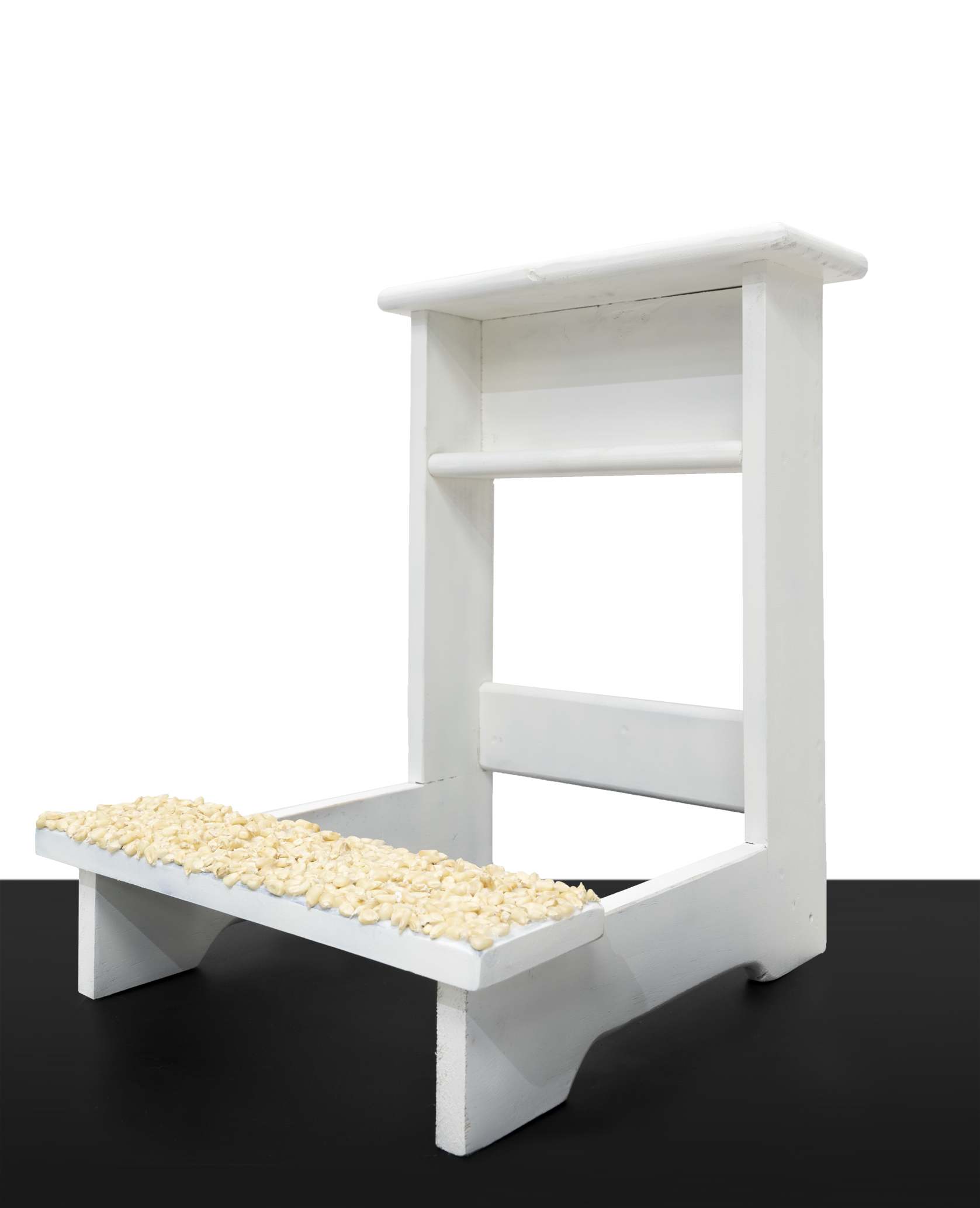
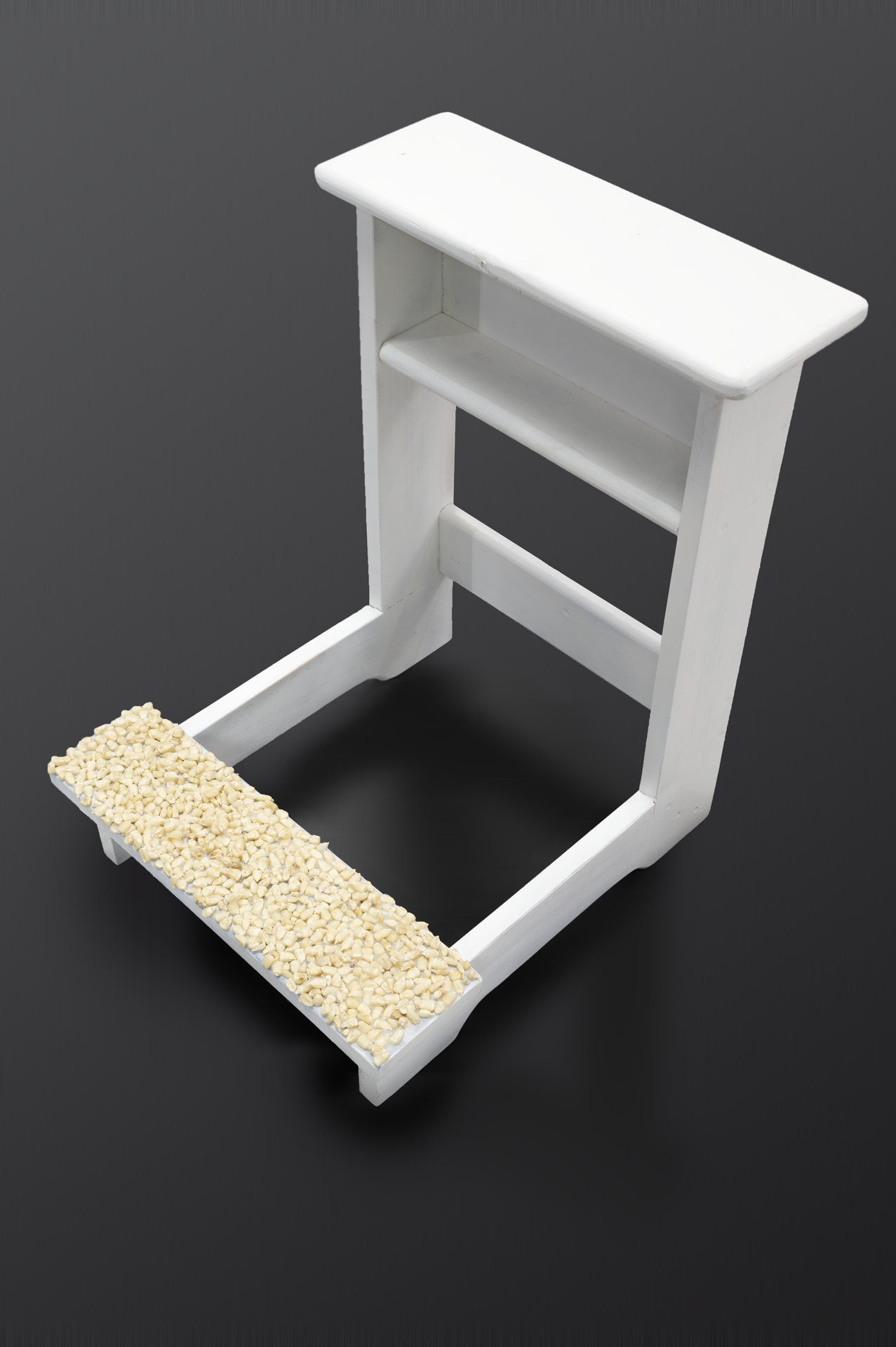
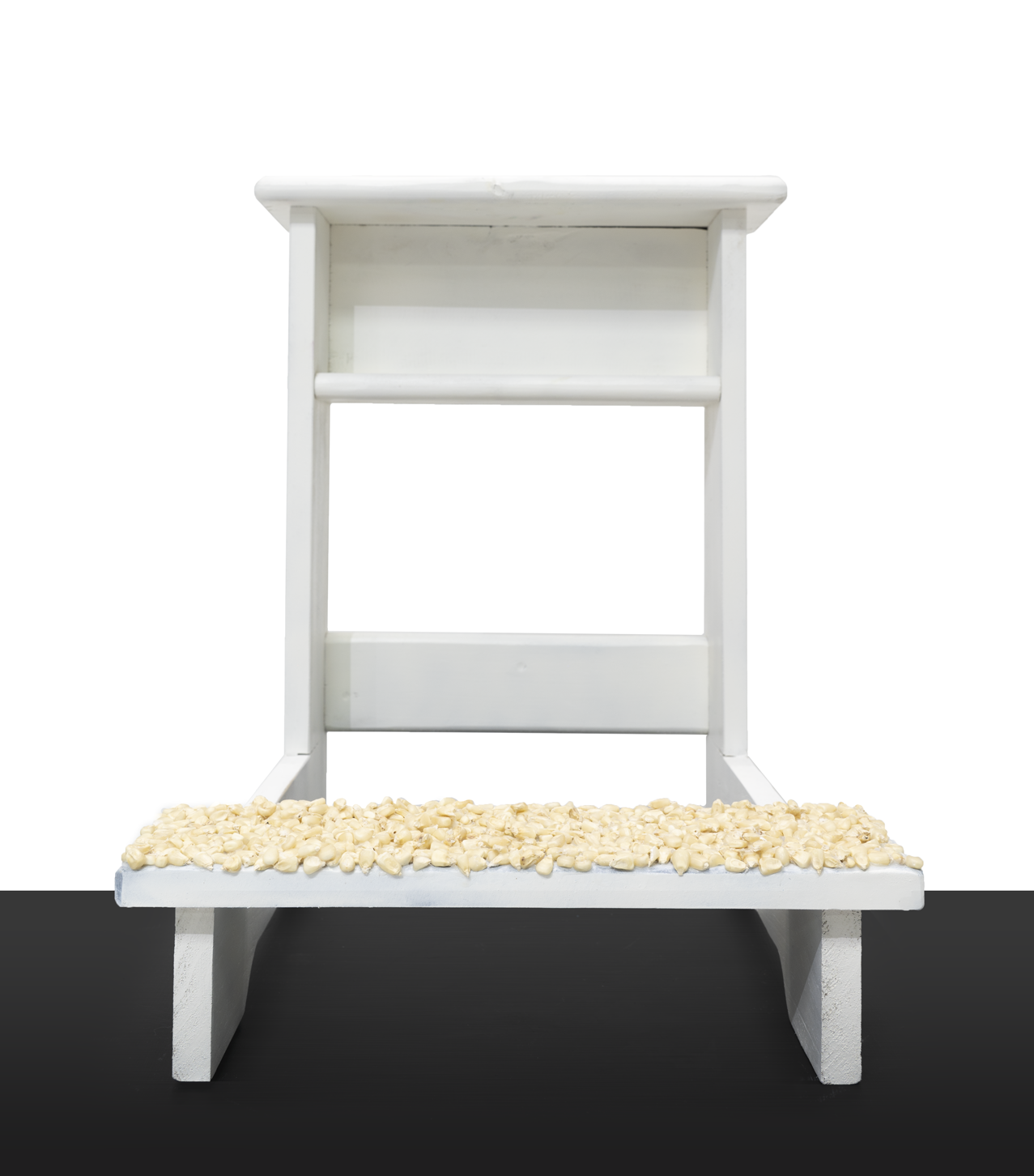
Reclinatorio parte de un objeto asociado con la oración y lo convierte en una estructura de castigo, fe y memoria corporal. Adquirí el reclinatorio infantil a un carpintero dedicado a fabricar este tipo de mobiliario religioso. La obra nace, por tanto, de un objeto real, inscrito en una tradición material vinculada con la devoción doméstica, el oficio artesanal y la educación moral de la infancia.
La pieza remite a una amenaza disciplinaria ampliamente reconocible en mi generación: hacer que un niño se arrodillara sobre granos de maíz como forma de corrección corporal. Sin embargo, el castigo no necesitaba ejecutarse para ser eficaz. Muchas veces bastaba con nombrarlo. La imagen de las rodillas presionadas contra los granos producía una anticipación del dolor que comenzaba a operar antes de cualquier contacto físico.
Me interesa especialmente ese momento en el que la amenaza entra en el cuerpo. El niño imagina la postura, el peso y la presión del maíz; aprende a evitar ciertas conductas no solo por lo que ha sucedido, sino por aquello que podría suceder. La obediencia se produce entonces mediante un dolor todavía inexistente. El cuerpo responde a una escena futura, la incorpora y modifica su conducta para impedir que llegue a realizarse.
Al colocar maíz crudo sobre la superficie destinada a las rodillas, la obra materializa esa amenaza suspendida. El reclinatorio permanece vacío, pero conserva la expectativa de un cuerpo. No muestra el castigo en ejecución ni representa al niño sometido; presenta el dispositivo preparado para recibirlo. La ausencia del cuerpo no elimina la violencia: hace visible que el mecanismo puede actuar incluso sin tocarlo.
La intervención vuelve inestable la frontera entre castigo y devoción. Un mismo gesto corporal —arrodillarse— puede significar oración, penitencia, entrega, corrección o sometimiento. La postura de la fe coincide con la postura del castigo. El objeto religioso puede enseñar simultáneamente recogimiento y obediencia, mientras el dolor aparece como una vía para corregir el cuerpo, purificar la conducta o demostrar la profundidad de una convicción.
Me interesa esa lógica aprendida en la que el sacrificio puede confundirse con virtud y la intensidad del dolor parece medir la sinceridad de la fe. La amenaza disciplinaria no actúa separada de la educación religiosa: ambas comparten una pedagogía donde resistir, callar, soportar y obedecer pueden presentarse como formas de formación moral.
Dentro de Máquinas heredadas, Reclinatorio funciona como una articulación temprana de las estructuras familiares, religiosas y pedagógicas que entran en el cuerpo antes de que podamos nombrarlas. La obra conserva una arquitectura mínima donde amenaza, oración y obediencia comparten la misma postura. Lo heredado no es únicamente una creencia o una norma, sino la anticipación corporal de aquello que puede ocurrir si esa norma no se obedece.
Materiales: reclinatorio infantil de madera adquirido a un carpintero, pintura blanca y maíz crudo
Dimensiones: pendientes
Objeto intervenido / pieza única
ENG.
KNEELER
c. 2006
Kneeler begins with an object associated with prayer and transforms it into a structure of punishment, faith, and bodily memory. I acquired the child-sized kneeler from a carpenter who specialized in making this type of religious furniture. The work therefore originates in a real object, embedded in a material tradition connected to domestic devotion, artisanal craft, and the moral education of children.
The piece refers to a disciplinary threat widely recognizable within my generation: forcing a child to kneel on grains of corn as a form of physical correction. The punishment, however, did not need to be carried out in order to be effective. Often, naming it was enough. The image of knees pressed against the grains produced an anticipation of pain that began operating before any physical contact occurred.
I am particularly interested in the moment when the threat enters the body. The child imagines the posture, the weight, and the pressure of the corn; they learn to avoid certain behaviors not only because of what has already happened, but because of what might happen. Obedience is therefore produced through pain that does not yet exist. The body responds to a future scene, internalizes it, and alters its behavior to prevent that scene from becoming real.
By placing uncooked corn on the surface intended for the knees, the work materializes this suspended threat. The kneeler remains empty, yet it retains the expectation of a body. It does not show the punishment being carried out or depict the child being subjected to it; instead, it presents the device prepared to receive them. The absence of the body does not eliminate the violence. It reveals that the mechanism can act even without touching it.
The intervention destabilizes the boundary between punishment and devotion. The same bodily gesture—kneeling—may signify prayer, penance, surrender, correction, or submission. The posture of faith coincides with the posture of punishment. The religious object can teach reverence and obedience simultaneously, while pain is presented as a means of correcting the body, purifying behavior, or demonstrating the depth of one’s conviction.
I am interested in this learned logic through which sacrifice can be confused with virtue and the intensity of pain may appear to measure the sincerity of faith. The disciplinary threat does not operate separately from religious education: both share a pedagogy in which enduring, remaining silent, tolerating pain, and obeying may be presented as forms of moral formation.
Within Inherited Machines, Kneeler functions as an early articulation of the family, religious, and pedagogical structures that enter the body before we are able to name them. The work preserves a minimal architecture in which threat, prayer, and obedience share the same posture. What is inherited is not only a belief or a rule, but the bodily anticipation of what may happen when that rule is not obeyed.
Materials: child-sized wooden prayer kneeler acquired from a carpenter, white paint, and uncooked corn
Dimensions: pending
Altered object / unique work
Ecuaciones
2008.
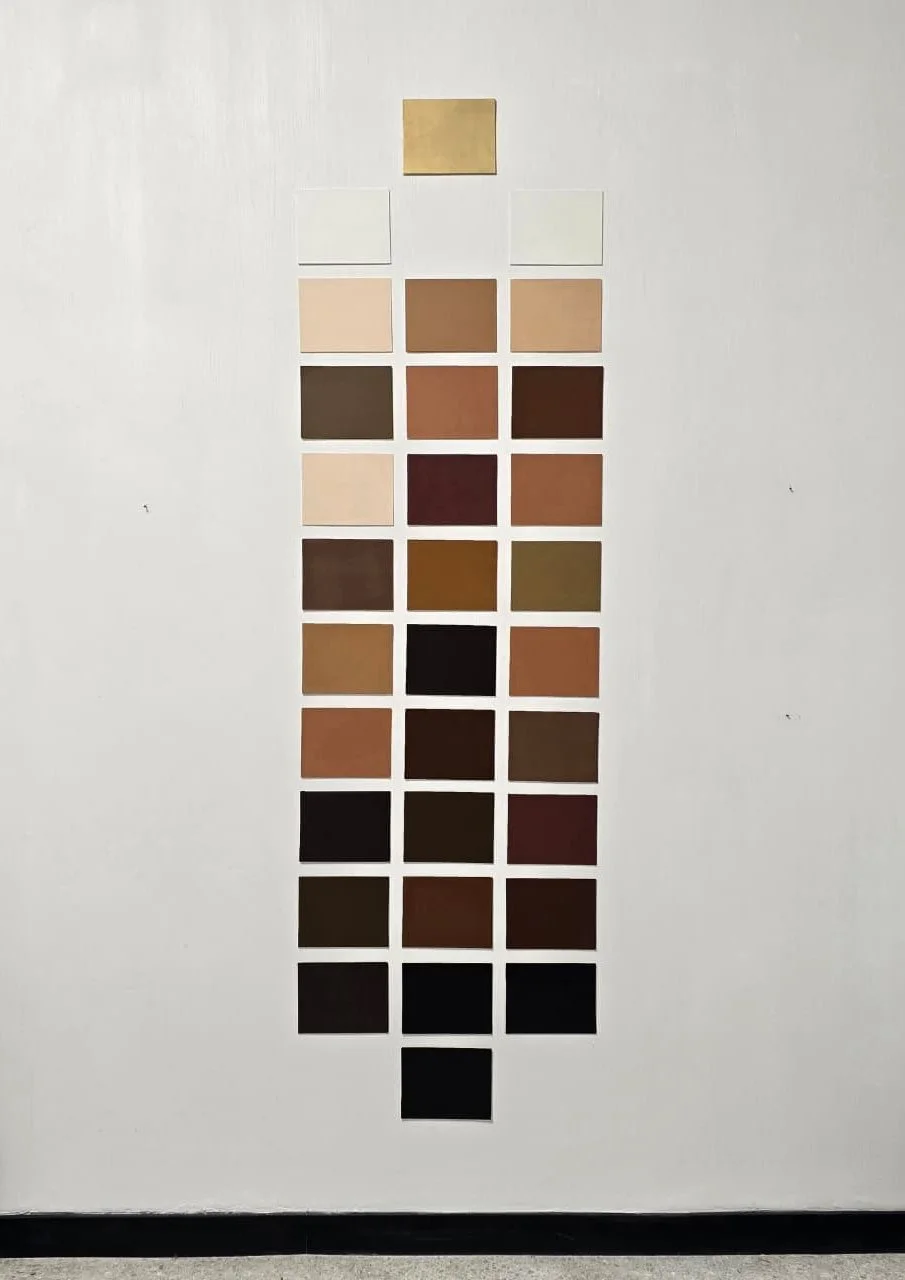
Ecuaciones parte de los sistemas de castas desarrollados durante el periodo colonial para clasificar a las personas según su ascendencia, el color de su piel y las combinaciones atribuidas a sus progenitores. Las pinturas de castas representaban estas genealogías mediante escenas familiares acompañadas por nombres que pretendían fijar la identidad y la posición social de cada descendiente. La mezcla se convertía así en una ecuación: dos categorías previamente establecidas producían una tercera, que volvía a ser nombrada y situada dentro de la jerarquía.
La obra conserva esa estructura mediante la fórmula padre + madre = hijo, pero sustituye la representación figurativa de los cuerpos por campos de color asociados con referencias Pantone. Cada persona queda reducida a una denominación, una combinación genealógica y un tono aparentemente preciso. El lenguaje visual contemporáneo del diseño y la reproducción industrial reemplaza la pintura colonial, pero mantiene activa su lógica de clasificación.
Pantone promete identificar y reproducir un color de manera consistente. Al trasladarlo a la piel, esa precisión se vuelve problemática: intenta convertir cuerpos diversos en muestras estables, comparables y administrables. La carta cromática produce una apariencia de neutralidad técnica, como si la identidad pudiera medirse sin prejuicio y el color existiera separado de las historias de poder que le han atribuido significado.
La violencia del sistema no se encuentra únicamente en términos como Cambujo, Tente en el aire, No te entiendo o Tornatrás. Está también en la estructura que los hace posibles: la pretensión de que una persona pueda ser explicada por la suma de sus procedencias y de que esa operación determine su pertenencia, su valor y el lugar que debe ocupar. Algunos nombres describen una supuesta composición racial; otros expresan directamente desconcierto, sospecha o imposibilidad de clasificación. Cuando la mezcla excede el vocabulario disponible, el sistema no abandona su autoridad: inventa una categoría nueva.
La repetición de las ecuaciones convierte la obra en una maquinaria visual. Los nombres y los tonos cambian, pero el procedimiento permanece. Cada resultado vuelve a ingresar al sistema como una nueva unidad clasificable, permitiendo que la jerarquía se reproduzca indefinidamente. La obra no intenta reconstruir fielmente una taxonomía histórica ni proponer correspondencias reales entre categorías y colores de piel. Utiliza la artificialidad de esas equivalencias para mostrar que toda clasificación racial depende de convenciones aprendidas, aun cuando se presente como observación objetiva.
Dentro de Máquinas heredadas, la pieza examina un sistema que continúa actuando después de que sus categorías oficiales han dejado de utilizarse. La taxonomía colonial permanece en formas contemporáneas de colorismo, pertenencia, exclusión y lectura social del cuerpo. Lo heredado no es solamente un conjunto de nombres, sino una manera de mirar: el impulso de calcular el origen de otra persona, interpretar su apariencia como evidencia y asignarle una posición antes de conocerla.
Al presentar las castas como ecuaciones cromáticas, la obra confronta dos tecnologías de estandarización separadas por siglos. Una organizó cuerpos mediante genealogías raciales; la otra organiza colores para garantizar su reproducción. Su encuentro revela cómo el lenguaje técnico puede hacer que una jerarquía construida parezca natural, exacta y neutral.
Materiales: Pintura acrílica, campos cromáticos, referencias Pantone y texto
Dimensiones: Variables
Edición / condición: por confirmar
ENG.
EQUATIONS
c. 2006
Casta Equations: Pantone Skin Tones begins with the caste systems developed during the colonial period to classify people according to their ancestry, skin color, and the combinations attributed to their parents. Casta paintings represented these genealogies through family scenes accompanied by names intended to fix the identity and social position of each descendant. Racial mixture was thus converted into an equation: two previously established categories produced a third, which was then named and positioned within the hierarchy.
The work retains this structure through the formula father + mother = child, but replaces figurative representations of bodies with fields of color associated with Pantone references. Each person is reduced to a designation, a genealogical combination, and an apparently precise tone. The contemporary visual language of design and industrial reproduction replaces colonial painting while keeping its classificatory logic active.
Pantone promises to identify and reproduce a color consistently. When applied to skin, this precision becomes problematic: it attempts to convert diverse bodies into stable, comparable, and administrable samples. The color chart produces an appearance of technical neutrality, as though identity could be measured without prejudice and color existed separately from the histories of power that have assigned meaning to it.
The violence of the system lies not only in terms such as Cambujo, Tente en el aire, No te entiendo, or Tornatrás. It also resides in the structure that makes such names possible: the assumption that a person can be explained through the sum of their origins, and that this operation can determine their belonging, value, and assigned social position. Some names describe a supposed racial composition; others directly express confusion, suspicion, or an inability to classify. When racial mixture exceeds the available vocabulary, the system does not relinquish its authority—it invents another category.
The repetition of the equations transforms the work into a visual machine. The names and tones change, but the procedure remains. Each result reenters the system as a new classifiable unit, allowing the hierarchy to reproduce itself indefinitely. The work does not attempt to reconstruct a historical taxonomy faithfully or propose actual correspondences between caste categories and skin colors. Instead, it uses the artificiality of these equivalences to reveal that every racial classification depends upon learned conventions, even when presented as objective observation.
Within Inherited Machines, the work examines a system that continues to operate after its official categories have fallen out of use. Colonial taxonomy persists in contemporary forms of colorism, belonging, exclusion, and the social reading of the body. What is inherited is not merely a collection of names, but a way of seeing: the impulse to calculate another person’s origins, interpret their appearance as evidence, and assign them a position before knowing them.
By presenting the castas as chromatic equations, the work brings together two technologies of standardization separated by centuries. One organized bodies through racial genealogies; the other organizes colors to ensure their reproducibility. Their encounter reveals how technical language can make a constructed hierarchy appear natural, exact, and neutral.
Materials: Acrylic paint, color fields, Pantone references, and text
Dimensions: pending
Edition / condition: tbd
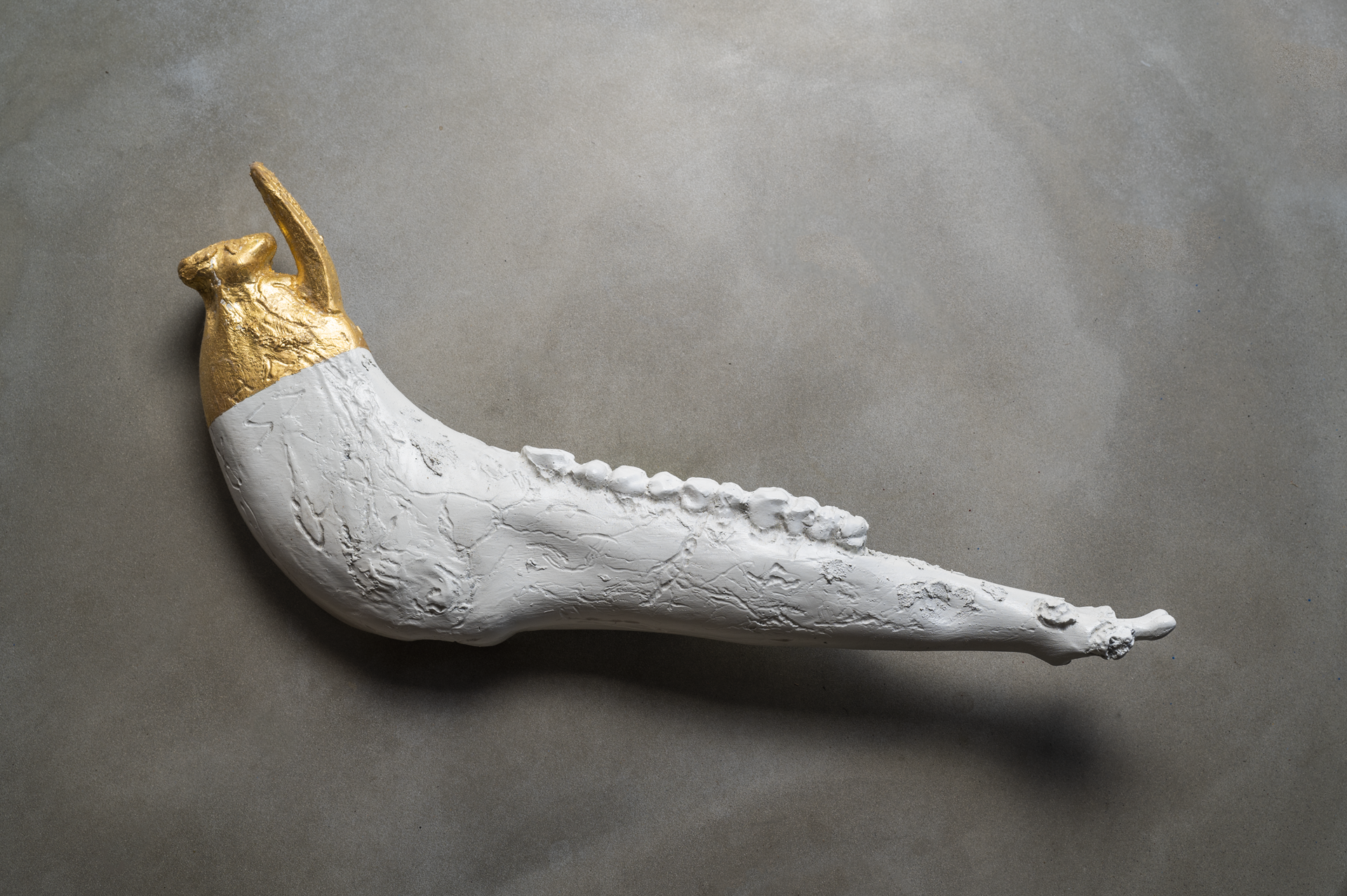
Marca heredada parte del asesinato de Abel y de la marca impuesta posteriormente a Caín. El Génesis no identifica el arma utilizada en el crimen; sin embargo, la mandíbula de burro aparece desde hace siglos en representaciones artísticas de la escena. En los relatos religiosos de carácter casi folclórico que conocí en América Latina, Caín también era presentado utilizando una mandíbula para matar a su hermano. Esa versión se superponía con la historia de Sansón, quien sí emplea una mandíbula de burro como arma. La obra parte de esa confusión y de la manera en que la repetición visual y oral puede unir relatos diferentes hasta instalarlos en la memoria como una misma verdad.
La escultura reproduce una mandíbula de burro modelada en resina y polvo de mármol, recubierta con hoja de oro de 24 quilates. La imaginé como un objeto transmitido de generación en generación: una herencia imposible que atraviesa a mis antepasados hasta llegar al primer crimen. Desde mi experiencia mestiza, la pieza no se refiere únicamente a aquello que heredamos biológicamente, sino también a las narraciones mediante las cuales aprendemos a interpretar nuestro origen, nuestra pertenencia y el cuerpo de los demás.
En el relato bíblico, la marca impuesta a Caín lo protege de ser asesinado. Interpretaciones racistas posteriores invirtieron esa función y la convirtieron en una señal visible del crimen, asociándola con la piel oscura y presentándola como una condición transmitida a sus descendientes. La culpabilidad de un individuo fue trasladada así a poblaciones y generaciones enteras, como si determinados cuerpos llevaran inscrito un crimen anterior a su propia existencia.
Durante siglos, iglesias, teólogos, predicadores y dirigentes religiosos utilizaron la marca de Caín, junto con otras interpretaciones bíblicas, para justificar la esclavitud, la segregación, la subordinación y la exclusión de las personas negras. Estas lecturas no permanecieron como opiniones aisladas: fueron enseñadas, convertidas en doctrina e incorporadas a estructuras institucionales. Brigham Young fue uno de sus exponentes más explícitos al identificar a las personas negras como descendientes de Caín y utilizar esa supuesta genealogía para justificar su exclusión de la autoridad religiosa. El racismo adquiría así la forma de un castigo heredado, aplicado como si respondiera a una sentencia divina anterior.
El oro convierte la mandíbula en reliquia y desplaza la violencia hacia el terreno de lo sagrado. Alude a la santificación de la sangre derramada, al sacrificio, al martirio y a la autoridad adquirida por una narración cuando es repetida como verdad. No oculta el arma ni elimina el crimen: preserva el mecanismo mediante el cual la violencia puede recibir valor, convertirse en doctrina y continuar actuando sobre otros.
Dentro de Máquinas heredadas, la obra examina una estructura capaz de transmitir simultáneamente el relato, la culpa y el castigo. Lo heredado no es únicamente la memoria de una violencia antigua, sino una forma de mirar que permite señalar ciertos cuerpos como portadores de una marca y responsabilizarlos por un crimen que nunca cometieron. La mandíbula funciona como una falsa evidencia transmitida que, al ser repetida, consagrada y convertida en doctrina, termina sosteniendo formas reales de discriminación y violencia.
ENG.
Inherited Mark begins with the murder of Abel and the mark subsequently placed upon Cain. Genesis does not identify the weapon used in the crime; however, the jawbone of a donkey has appeared for centuries in artistic representations of the scene. In the almost folkloric religious accounts I encountered in Latin America, Cain was also described as using a jawbone to kill his brother. This version overlapped with the story of Samson, who does use a donkey’s jawbone as a weapon. The work emerges from that confusion and from the way visual and oral repetition can merge different narratives until they become fixed in memory as a single truth.
The sculpture reproduces a donkey’s jawbone modeled in resin and marble dust and covered with 24-karat gold leaf. I imagined it as an object passed down from one generation to another: an impossible inheritance extending through my ancestors to the first murder. From my mestizo experience, the work refers not only to what we inherit biologically, but also to the narratives through which we learn to interpret our origins, our belonging, and the bodies of others.
In the biblical account, the mark placed upon Cain protects him from being killed. Later racist interpretations reversed this function, transforming it into visible evidence of his crime, associating it with Black skin, and presenting it as a condition transmitted to his descendants. The guilt of one individual was thus transferred onto entire populations and generations, as though certain bodies carried the inscription of a crime committed before their own existence.
For centuries, churches, theologians, preachers, and religious leaders used the mark of Cain, together with other biblical interpretations, to justify the enslavement, segregation, subordination, and exclusion of Black people. These readings did not remain isolated opinions: they were taught, converted into doctrine, and incorporated into institutional structures. Brigham Young was among their most explicit proponents, identifying Black people as descendants of Cain and using this supposed genealogy to justify their exclusion from religious authority. Racism was thereby presented as an inherited punishment, enforced as though it fulfilled an earlier divine sentence.
Gold transforms the jawbone into a relic and shifts violence into the realm of the sacred. It evokes the sanctification of spilled blood, sacrifice, martyrdom, and the authority acquired by a narrative when it is repeated as truth. It neither conceals the weapon nor erases the crime; it preserves the mechanism through which violence can be granted value, converted into doctrine, and allowed to continue acting upon others.
Within Inherited Machines, the work examines a structure capable of transmitting narrative, guilt, and punishment simultaneously. What is inherited is not only the memory of an ancient act of violence, but also a way of seeing that allows certain bodies to be marked and held responsible for a crime they never committed. The jawbone functions as false evidence passed down through generations—evidence that, once repeated, consecrated, and transformed into doctrine, comes to sustain real forms of discrimination and violence.
Marca heredada, 2003
2014.
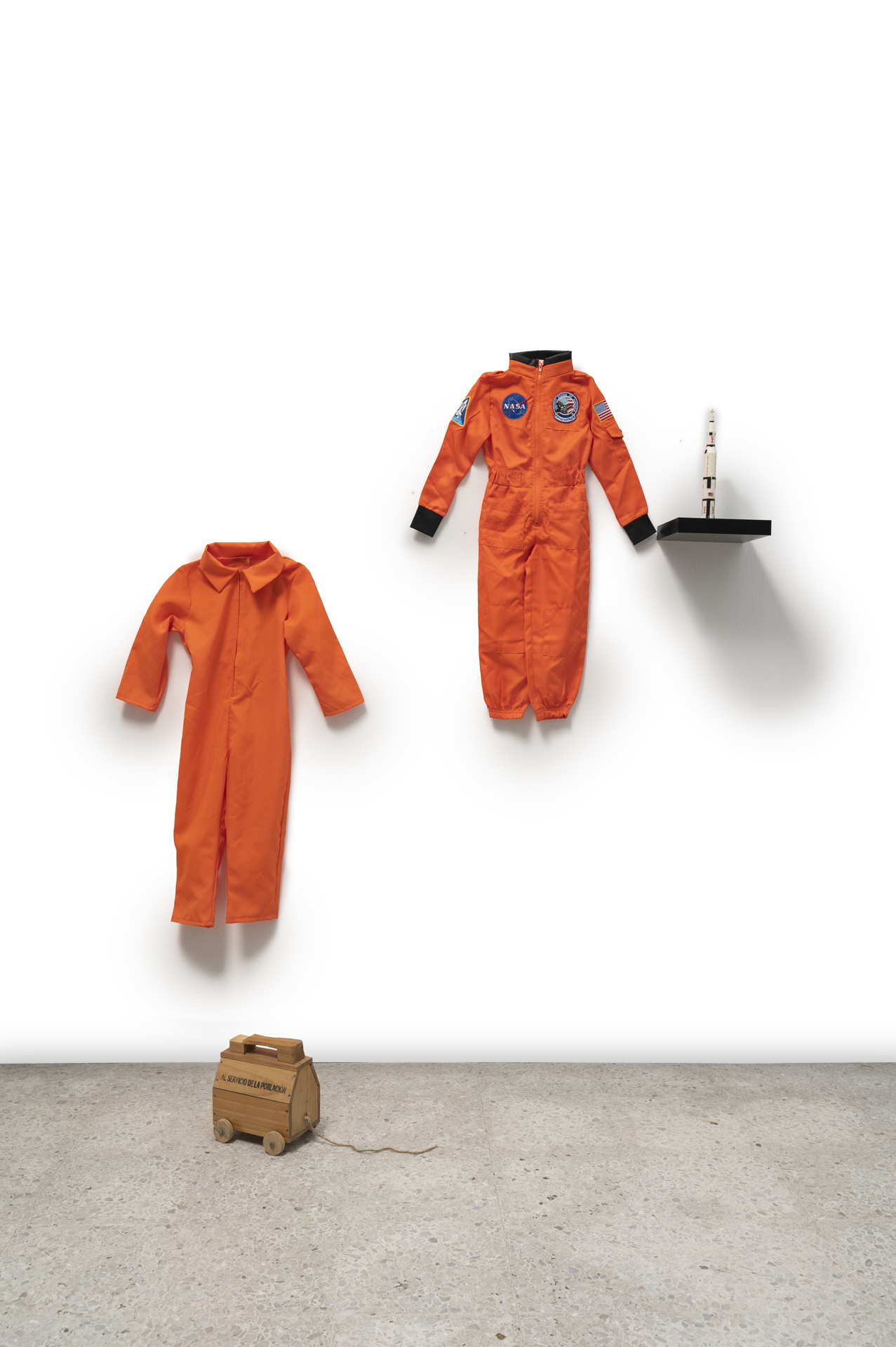
Al servicio de la población forma parte de mi investigación sobre infancia, clase, trabajo, fe y obediencia como estructuras heredadas. La obra nace de un episodio en el que niños lustradores fueron uniformados y presentados públicamente mediante un lenguaje de servicio, civismo y pertenencia política. Me interesó cómo una situación de trabajo infantil podía ser recodificada como organización, identidad colectiva u orgullo cívico, desplazando la violencia estructural hacia una imagen aparentemente ordenada.
La instalación reúne objetos que pertenecen a imaginarios opuestos de infancia. Una caja de lustre de madera, fabricada como juguete infantil para ser entregada a niños pobres, introduce una contradicción central: aquello que se ofrece como juguete no amplía el espacio de la imaginación, sino que ensaya anticipadamente una función de trabajo y servicio. A la caja le añadí ruedas como símbolo de movilidad horizontal. Puede desplazarse, recorrer la calle y mantenerse en actividad, pero ese movimiento no implica necesariamente una transformación de la posición social que le ha sido asignada.
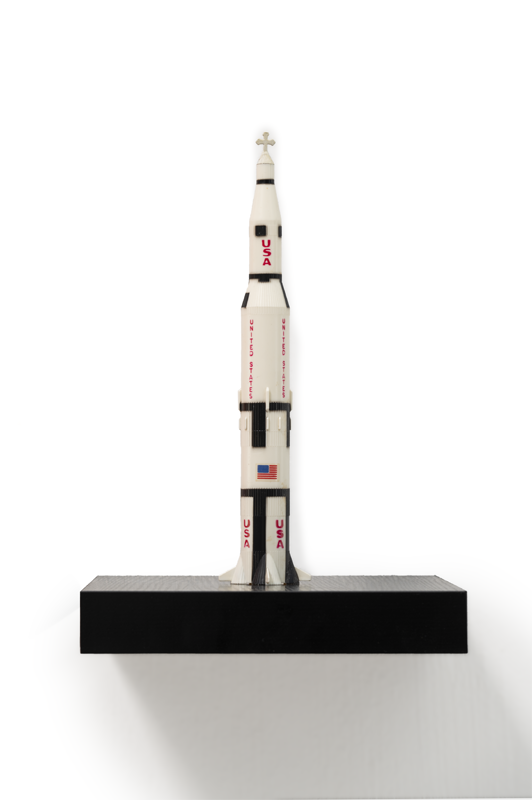
Frente a ella, un traje infantil de astronauta y un cohete de juguete evocan otra pedagogía del deseo, en la que jugar permite proyectarse fuera de lo conocido e imaginar un futuro todavía abierto. La diferencia no reside únicamente en los objetos, sino en los futuros que cada uno permite ensayar: mientras unos juguetes expanden la posibilidad, otros preparan a la infancia para volverse útil.
La obra se organiza verticalmente como una escena de distancia social: el suelo sostiene el trabajo como destino, mientras el muro eleva el sueño como una posibilidad distribuida de manera jerarquizada. La cruz incorporada al cohete introduce una dimensión religiosa vinculada con la fe, la recompensa y el destino, evitando que la instalación se reduzca a una crítica exclusivamente económica.
No me interesa presentar la pobreza como el punto de partida de una narrativa de superación, sino señalar cómo esa narrativa suele convertir una desigualdad estructural en una prueba de mérito individual. La pieza muestra cómo ciertos sistemas —familia, religión, escuela, Estado y clase— enseñan a los cuerpos no solo qué hacer, sino también hasta dónde pueden desplazarse y qué están autorizados a imaginar.
Materiales: overol infantil, traje infantil de astronauta, cohete de juguete intervenido, caja de lustre de madera fabricada como juguete infantil, ruedas, cuerda y texto
Dimensiones: variables según instalación
Pieza única
ENG.
AT THE SERVICE OF THE POPULATION
2014
At the Service of the Population forms part of my investigation into childhood, class, labor, faith, and obedience as inherited structures. The work originated from an episode in which child shoeshiners were uniformed and publicly presented through a language of service, civic order, and political belonging. I became interested in how a situation of child labor could be recoded as organization, collective identity, or civic pride, displacing structural violence into an apparently orderly image.
The installation brings together objects belonging to opposing imaginaries of childhood. A wooden shoeshine box, manufactured as a children’s toy to be given to poor children, introduces a central contradiction: what is offered as a toy does not expand the space of imagination, but rehearses a function of labor and service in advance. I added wheels to the box as a symbol of horizontal mobility. It can move, circulate through the street, and remain in constant activity, yet this movement does not necessarily transform the social position already assigned to it.
In contrast, a child’s astronaut suit and a toy rocket evoke another pedagogy of desire, one in which play allows a child to project themselves beyond the known and imagine a future that remains open. The difference lies not only in the objects themselves, but in the futures each one allows a child to rehearse: while some toys expand possibility, others prepare childhood to become useful.
The installation is organized vertically as a scene of social distance: the ground sustains labor as destiny, while the wall elevates the dream as a possibility distributed hierarchically. The cross incorporated into the rocket introduces a religious dimension related to faith, reward, and destiny, preventing the work from being reduced to an exclusively economic critique.
I am not interested in presenting poverty as the starting point of a narrative of self-improvement, but in showing how such narratives often convert structural inequality into a test of individual merit. The work reveals how certain systems—family, religion, school, the state, and class—teach bodies not only what to do, but also how far they may move and what they are permitted to imagine.
Materials: child’s coverall, child’s astronaut suit, altered toy rocket, wooden shoeshine box manufactured as a children’s toy, wheels, rope, and text
Dimensions: variable according to installation
Unique work
Al servicio de la población
Serie desarrollada de forma intermitente entre 2002 y 2015
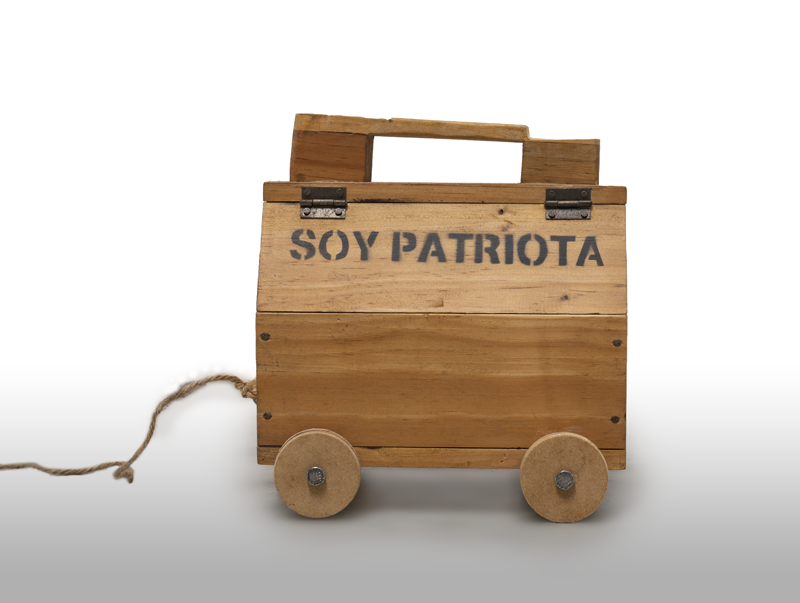
A lo largo de varios años regresé a la caja de lustre como una estructura elemental de trabajo, servicio y asignación social. El objeto contiene los instrumentos necesarios para limpiar zapatos, sostiene el pie del cliente y debe transportarse durante los recorridos por la calle. Su escala, su forma y su uso organizan una relación precisa entre dos cuerpos: uno permanece arriba mientras el otro se inclina frente a él.
La serie parte de la presencia cotidiana de niños lustradores en Guatemala. Más que representar el trabajo infantil, examina el mecanismo que permite considerarlo normal: la manera en que la necesidad ocupa el tiempo de la infancia, determina una postura y asigna una función antes de que exista una posibilidad real de elegirla. La caja permite obtener un ingreso inmediato, pero también materializa un orden social en el que ciertas infancias aprenden demasiado pronto a servir, producir y sobrevivir.
Cada pieza fue realizada en un momento distinto e interviene la caja mediante materiales relacionados con el daño, el desgaste y la exposición: hierro, púas, raíces muertas, madera quemada, humo y superficies ennegrecidas. Estas modificaciones no introducen una violencia ajena al objeto. Hacen visible aquello que su presencia habitual puede llegar a ocultar: precariedad, peligro, enfermedad, agotamiento y la reducción anticipada de los futuros posibles.
El título entiende la caja como una máquina sin motor. Su mecanismo se activa cuando organiza la postura de los cuerpos, establece quién presta el servicio y quién lo recibe, y convierte la calle en espacio de producción. No necesita formular una orden: su propia forma indica dónde colocarse, qué tarea realizar y qué lugar parece estar disponible.
Dentro de Máquinas heredadas, la serie observa cómo una posición social puede reproducirse mediante objetos y conductas aparentemente ordinarios. La supervivencia aparece como una respuesta necesaria, pero también como parte de una estructura que se mantiene en funcionamiento porque obliga a adaptarse a ella. Las cajas conservan el registro de una asignación que comienza antes de la elección y puede repetirse de una generación a otra.
ENG.
MACHINES OF ASSIGNMENT
Series developed intermittently between 2002 and 2015
Over the course of several years, I returned to the shoeshine box as an elementary structure of labor, service, and social assignment. The object contains the tools needed to clean shoes, supports the client’s foot, and must be carried through the streets. Its scale, form, and use organize a precise relationship between two bodies: one remains above while the other bends down before it.
The series begins with the everyday presence of children who shine shoes in Guatemala. Rather than representing child labor, it examines the mechanism through which it comes to be perceived as normal: the way necessity occupies childhood, determines a posture, and assigns a function before there is any real possibility of choosing it. The box makes it possible to earn an immediate income, but it also materializes a social order in which certain children learn far too early to serve, produce, and survive.
Each work was made at a different moment and alters the box through materials associated with damage, exhaustion, and exposure: iron, spikes, dead roots, burned wood, smoke, and blackened surfaces. These modifications do not introduce a form of violence that is foreign to the object. They make visible what its familiar presence may conceal: precarity, danger, illness, exhaustion, and the premature reduction of possible futures.
The title understands the box as a machine without a motor. Its mechanism is activated whenever it organizes the position of bodies, establishes who provides a service and who receives it, and transforms the street into a site of production. It does not need to issue an order: its form already indicates where to stand, what task to perform, and what place appears to be available.
Within Inherited Machines, the series considers how a social position can be reproduced through seemingly ordinary objects and behaviors. Survival appears as a necessary response, but also as part of a structure that remains in operation because it compels people to adapt to it. The boxes preserve the record of an assignment that begins before choice and may be repeated from one generation to the next.
Máquinas de asignación
SOBRE LAS CAJAS DE LUSTRE
Mi interés por las cajas de lustre comenzó antes de que pudiera comprenderlo como una investigación artística. Desde los doce o trece años recorría la ciudad en patineta y bicicleta. Durante esos desplazamientos empecé a encontrarme con niños lustradores, niños que vivían en la calle y otras infancias que habitaban el espacio público desde un lugar completamente distinto al mío. Yo también tuve una infancia compleja, pero no carente. Esa diferencia me marcó: comprender que no todas las infancias tienen acceso al mismo juego, al mismo cuidado ni a la misma posibilidad de imaginar el futuro.
Años después, a través del graffiti y de mi relación con la cultura de la calle, pude conversar con muchos de ellos. Escuché historias de trabajo impuesto, abandono, racismo, extorsión policial, violencia familiar, abuso, adicciones y formas extremas de supervivencia. También encontré algo que me impresionó profundamente: a pesar de la dureza de sus condiciones, muchos conservaban una fuerza vital y una capacidad de aspiración extraordinarias. La distancia entre la brutalidad de aquello que enfrentaban y la intensidad de sus deseos se convirtió en una pregunta persistente dentro de mi obra.
No hablo por los niños lustradores ni intento representar sus experiencias como si me pertenecieran. Hablo de la máquina heredada que les asigna ese lugar. Me interesa el conjunto de estructuras familiares, económicas, raciales, religiosas, políticas y culturales que enseñan a ciertas infancias a trabajar, servir, resistir y sobrevivir demasiado pronto. La caja de lustre aparece como un dispositivo donde esa maquinaria se vuelve visible.
La caja no es solamente una herramienta ni un símbolo de pobreza. Es un objeto donde se cruzan múltiples herencias: la caridad, la disciplina, la explotación, la utilidad, la obediencia, el orgullo de “ganarse la vida”, la normalización del trabajo infantil y la promesa de que el esfuerzo individual puede resolver una desigualdad producida estructuralmente. Incluso acciones presentadas como ayuda —regalar cajas, organizar a los niños, uniformarlos o enseñarles a trabajar— pueden formar parte de una misma lógica que convierte la infancia en servicio.
Me interesa especialmente cómo estas estructuras operan sin necesidad de mostrarse como violencia. Con frecuencia aparecen bajo los nombres de ayuda, oportunidad, formación, civismo, responsabilidad o superación. Detrás de esas palabras existe una pedagogía social que distribuye de manera jerarquizada la posibilidad de imaginar. Algunos niños reciben juguetes con los que ensayan futuros; otros reciben objetos con los que ensayan el trabajo. Algunos son protegidos para soñar; otros son reconocidos cuando demuestran que pueden ser útiles.
Regresé a las cajas de lustre durante varios años porque cada una me permitió examinar una dimensión diferente de esa asignación. Utilizo estos objetos porque condensan una historia material de infancia, clase, racialización, trabajo y deseo. En ellos se cruzan el juego y la obligación, el cuidado y el abandono, la ayuda y el control. Son pequeñas arquitecturas de una máquina mayor: una sociedad que enseña desde temprano qué cuerpos pueden jugar, cuáles deben servir, cuáles pueden imaginar y cuáles deben aprender a sobrevivir.
ON SHOESHINE BOXES
My interest in shoeshine boxes began before I could understand it as an artistic investigation. From the age of nine or ten, I moved through the city on a skateboard and BMX bicycle. During these journeys, I began encountering children who shined shoes, children living on the street, and other childhoods that inhabited public space from a position entirely different from my own. My childhood was also complex, but it was not deprived. That difference marked me: the realization that not every child has access to the same forms of play, care, or possibility of imagining the future.
Years later, through graffiti and my relationship with street culture, I was able to speak with many of them. I heard stories of imposed labor, abandonment, racism, police extortion, family violence, abuse, addiction, and extreme forms of survival. I also encountered something that affected me deeply: despite the harshness of their circumstances, many retained an extraordinary vitality and capacity for aspiration. The distance between the brutality of what they faced and the intensity of their desires became a persistent question within my work.
I do not speak on behalf of children who shine shoes, nor do I attempt to represent their experiences as though they belonged to me. I speak about the inherited machine that assigns them that position. I am interested in the family, economic, racial, religious, political, and cultural structures that teach certain children to work, serve, endure, and survive far too early. The shoeshine box appears as a device through which that machinery becomes visible.
The box is not merely a tool or a symbol of poverty. It is an object in which multiple inheritances intersect: charity, discipline, exploitation, usefulness, obedience, the pride associated with “earning a living,” the normalization of child labor, and the promise that individual effort can resolve an inequality produced structurally. Even actions presented as assistance—giving children boxes, organizing them, placing them in uniforms, or teaching them to work—can form part of the same logic that converts childhood into service.
I am particularly interested in how these structures operate without needing to present themselves as violence. They frequently appear under the names of assistance, opportunity, education, civic responsibility, discipline, or self-improvement. Behind these terms lies a social pedagogy that distributes the possibility of imagining in a hierarchical manner. Some children receive toys through which they rehearse possible futures; others receive objects through which they rehearse labor. Some are protected so they may dream; others are recognized when they demonstrate that they can be useful.
I returned to shoeshine boxes over several years because each one allowed me to examine a different dimension of this assignment. I use these objects because they condense a material history of childhood, class, racialization, labor, and desire. Within them, play intersects with obligation, care with abandonment, and assistance with control. They are small architectures of a larger machine: a society that teaches from an early age which bodies may play, which must serve, which may imagine, and which must learn to survive.
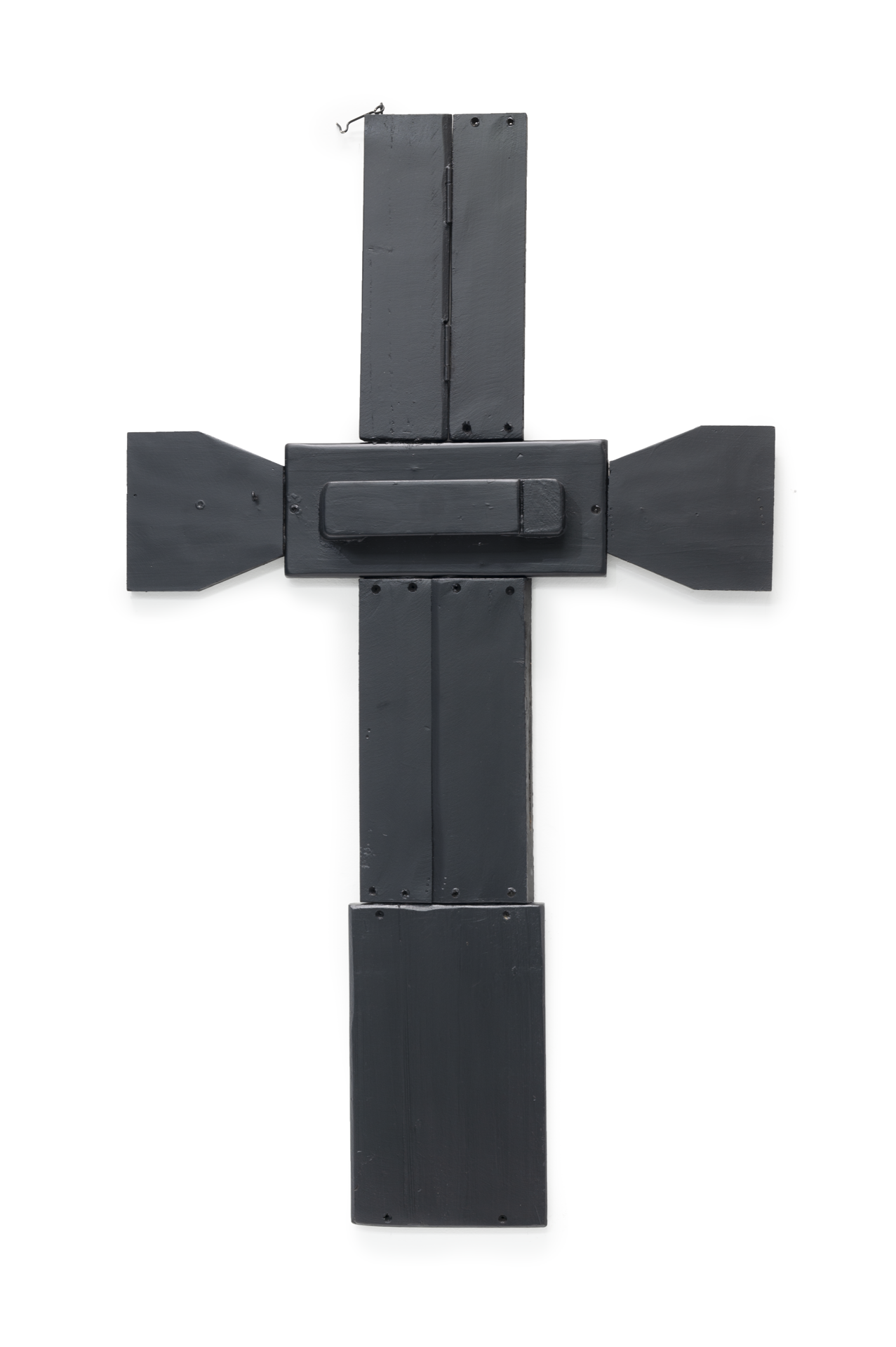
Santificación del trabajo fue realizada a partir de una caja de lustre adquirida a un carpintero tradicional que fabricaba estos objetos para su uso en las calles de Guatemala. La caja fue desarmada y desplegada hasta formar una estructura semejante a una cruz, posteriormente intervenida con pintura negra.
La transformación revela una relación entre trabajo, sacrificio y religión que ya estaba contenida en el objeto. La caja deja de ser únicamente una herramienta portátil y adquiere la forma de un símbolo religioso asociado con obediencia, sufrimiento y redención. El esfuerzo deja de aparecer como consecuencia de una estructura social y comienza a presentarse como virtud moral.
La obra examina los discursos que dignifican el trabajo infantil mediante ideas como disciplina, responsabilidad, sacrificio o superación. Bajo esta lógica, la necesidad de trabajar demasiado pronto puede ser interpretada como formación del carácter, mientras las condiciones que producen esa necesidad permanecen intactas. La pobreza se convierte en una prueba que debe soportarse y el servicio en una conducta que merece reconocimiento.
El negro unifica las partes y convierte la caja desplegada en una presencia severa, cercana al luto y al objeto ritual. La cruz no señala una salvación futura: expone el mecanismo mediante el cual el sufrimiento puede ser santificado y una posición social heredada puede presentarse como destino, deber o mérito personal.
Dentro de Máquinas de asignación, esta obra introduce la caja de lustre como una estructura que no solo organiza una tarea, sino también una pedagogía del cuerpo. Enseña a inclinarse, a servir y a comprender el esfuerzo como valor, incluso cuando ese esfuerzo comienza antes de que exista una posibilidad real de elegirlo.
Materiales: caja de lustre de madera, pintura negra
Dimensiones: por confirmar
Pieza única
ENG.
SANCTIFICATION OF LABOR
2002
Sanctification of Labor was made from a shoeshine box acquired from a traditional carpenter who produced these objects for use on the streets of Guatemala. The box was dismantled and unfolded into a structure resembling a cross, then covered with black paint.
This transformation reveals a relationship between labor, sacrifice, and religion that was already contained within the object. The box ceases to function solely as a portable tool and takes on the form of a religious symbol associated with obedience, suffering, and redemption. Labor no longer appears as the consequence of a social structure and instead begins to be presented as a moral virtue.
The work examines the discourses through which child labor is dignified using ideas such as discipline, responsibility, sacrifice, and self-improvement. Within this logic, the need to work too early may be interpreted as character building, while the conditions that produce that necessity remain intact. Poverty becomes a trial to be endured, and service a form of conduct deemed worthy of recognition.
Black unifies the separate parts and transforms the unfolded box into a severe presence, close to both mourning and a ritual object. The cross does not point toward future salvation; it exposes the mechanism through which suffering can be sanctified and an inherited social position presented as destiny, duty, or personal merit.
Within Machines of Assignment, the work introduces the shoeshine box as a structure that organizes not only a task, but also a pedagogy of the body. It teaches a person to bend down, to serve, and to understand effort as a virtue, even when that effort begins before there is any real possibility of choosing it.
Materials: wooden shoeshine box, black paint
Dimensions: to be confirmed
Unique work
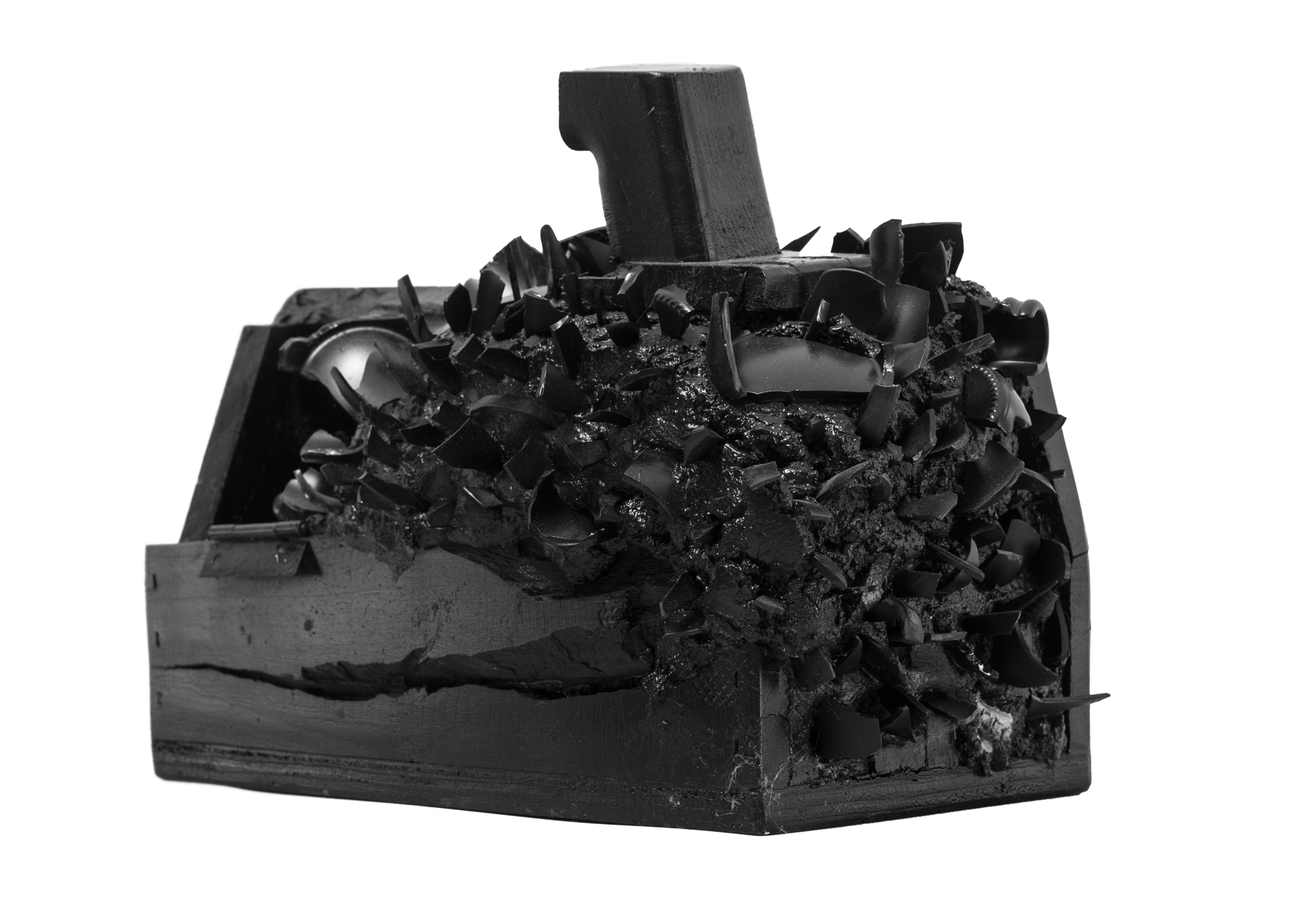
CAJA DE SEGURIDAD
2007
Caja de seguridad parte de una caja de lustre intervenida con concreto, fragmentos de vidrio y pintura negra. Los materiales remiten a una forma de protección frecuente en la arquitectura urbana de Guatemala: muros coronados con vidrio roto para impedir el paso y convertir el límite de una propiedad en una amenaza visible.
Trasladado a la caja, ese sistema defensivo transforma una herramienta de trabajo en una pequeña arquitectura fortificada. El objeto que debe circular por la calle se vuelve pesado, peligroso y difícil de transportar. Aquello que prometía cierta posibilidad de sustento adopta las mismas formas mediante las cuales la ciudad protege la propiedad y excluye a quienes permanecen fuera de ella.
El título alude tanto a la caja de lustre como a la idea de un contenedor destinado a resguardar algo valioso. Sin embargo, aquí la seguridad no protege a quien utiliza el objeto. El concreto y el vidrio preservan una estructura, pero hacen imposible habitarla sin riesgo. Protección y violencia dejan de aparecer como fuerzas opuestas: se construyen con los mismos materiales y pueden actuar simultáneamente.
Dentro de Máquinas de asignación, la obra examina la contradicción de una sociedad que expone a ciertas infancias al trabajo en el espacio público mientras refuerza sus propiedades mediante muros, vigilancia y superficies cortantes. La caja reproduce en pequeña escala esa distribución: unos cuerpos son resguardados detrás de la arquitectura; otros deben aprender a desplazarse frente a ella.
Materiales: caja de lustre de madera, concreto, vidrio roto y pintura negra
Dimensiones: por confirmar
Pieza única
ENG.
SAFETY BOX
2004
Safety Box begins with a shoeshine box altered with concrete, fragments of broken glass, and black paint. The materials refer to a common form of protection in Guatemala’s urban architecture: walls crowned with broken glass to prevent passage and turn the boundary of a property into a visible threat.
Transferred onto the box, this defensive system transforms a tool of labor into a small fortified architecture. The object intended to circulate through the streets becomes heavy, dangerous, and difficult to carry. What once offered a possible means of subsistence adopts the same forms through which the city protects property and excludes those who remain outside it.
The title refers both to the shoeshine box and to the idea of a container intended to safeguard something valuable. Here, however, security does not protect the person who uses the object. Concrete and glass preserve a structure while making it impossible to inhabit without risk. Protection and violence no longer appear as opposing forces: they are built from the same materials and can operate simultaneously.
Within Machines of Assignment, the work examines the contradiction of a society that exposes certain children to labor in public space while reinforcing private property through walls, surveillance, and cutting surfaces. The box reproduces this distribution on a smaller scale: some bodies are protected behind architecture, while others must learn to move in front of it.
Materials: wooden shoeshine box, concrete, broken glass, and black paint
Dimensions: to be confirmed
Unique work
SIN TÍTULO
c. 2009
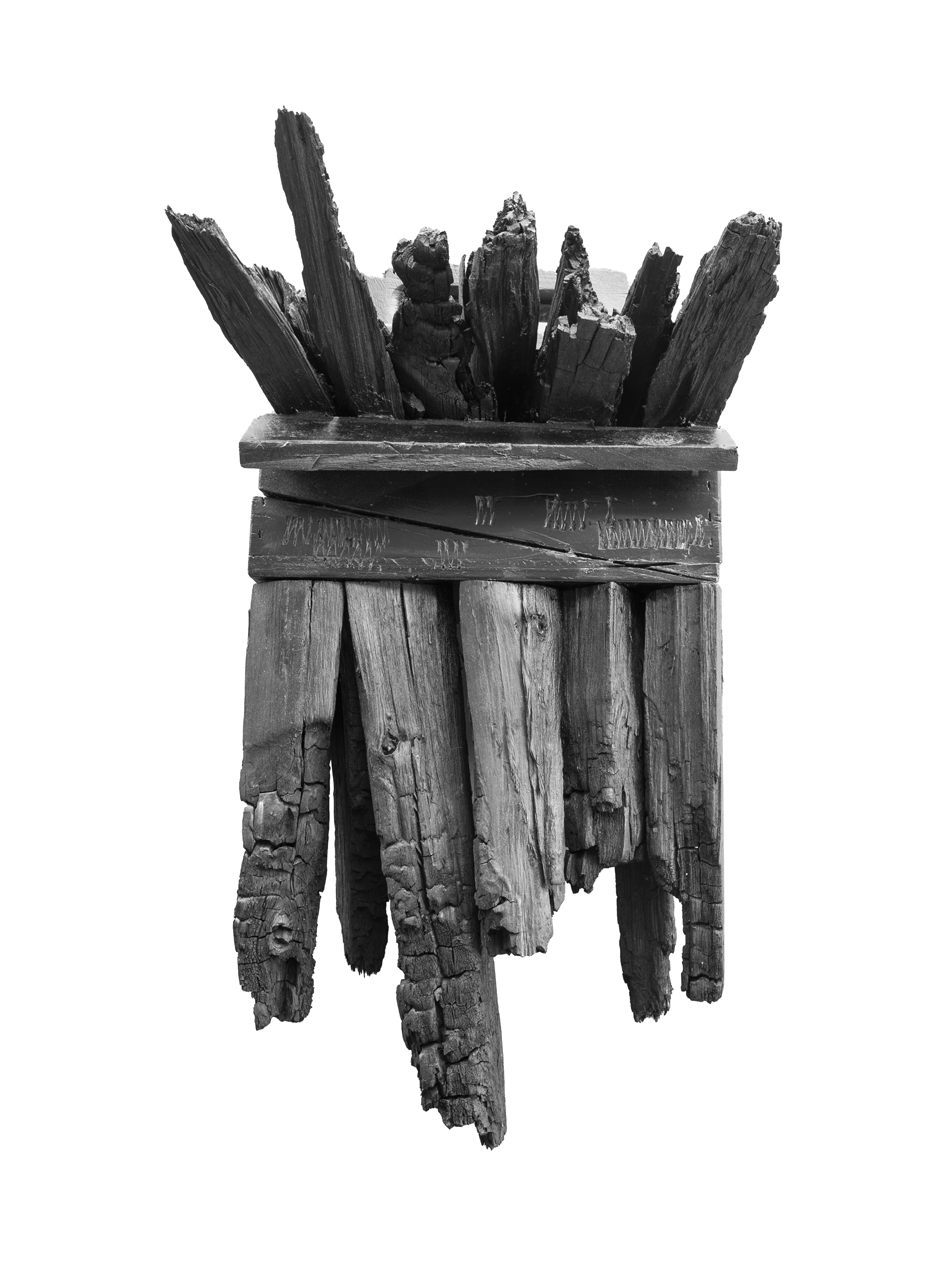
A diferencia de otras piezas de la serie, en las que la caja se relaciona directamente con el trabajo infantil en el espacio público, aquí el objeto se desplaza hacia el interior doméstico. La caja aparece cargada con leña real utilizada para cocinar en casas de distintas familias, incorporando una materia atravesada por alimento, humo, cuidado, desgaste y exposición.
La pieza no presenta la cocina únicamente como un gesto de afecto, sino como una condición estructural en la que alimentar también puede implicar daño. La leña sostiene la vida cotidiana, pero su combustión prolongada en espacios precarios puede afectar la respiración, la salud y el desarrollo de quienes habitan la casa. En ese cruce, la obra observa una forma silenciosa de herencia: no solo se heredan oficios, creencias o posiciones sociales; también se heredan tecnologías, aires, hábitos y condiciones materiales que entran al cuerpo antes de poder ser nombradas.
Dentro de mi práctica, la caja funciona como un dispositivo que condensa trabajo, cuidado y desigualdad. La obra no habla por quienes utilizan leña para cocinar ni romantiza la precariedad. Examina la máquina que hace que ciertas formas de supervivencia lleguen a considerarse normales, incluso cuando dejan marcas lentas en el cuerpo.
Materiales: Caja de lustre de madera intervenida con leña utilizada para cocinar en casas de distintas familias y pintura negra
Pieza única
Dimensiones pendientes
ENG.
UNTITLED
c. 2009
This work belongs to a body of work developed from shoeshine boxes understood as inherited machines. Unlike other pieces in the series, in which the box is directly connected to child labor in public space, here the object moves into the domestic interior. The box is filled with actual firewood used for cooking in the homes of different families, incorporating a material marked by food, smoke, care, exhaustion, and exposure.
The work does not present cooking solely as an act of affection, but as a structural condition in which feeding others may also cause harm. Firewood sustains everyday life, yet its prolonged combustion in precarious spaces can affect the breathing, health, and development of those who inhabit the home. At this intersection, the work examines a silent form of inheritance: occupations, beliefs, and social positions are not the only things passed down; technologies, the air people breathe, habits, and material conditions may also be inherited, entering the body before they can be named.
Within my practice, the box functions as a device that condenses labor, care, and inequality. The work does not speak on behalf of those who use firewood for cooking, nor does it romanticize precarity. It examines the machine through which certain forms of survival come to be regarded as normal, even when they leave slow marks upon the body.
Materials: shoeshine box altered with firewood used for cooking in the homes of different families and black paint
Dimensions: pending
Unique work
BLINDAJE
c. 2010
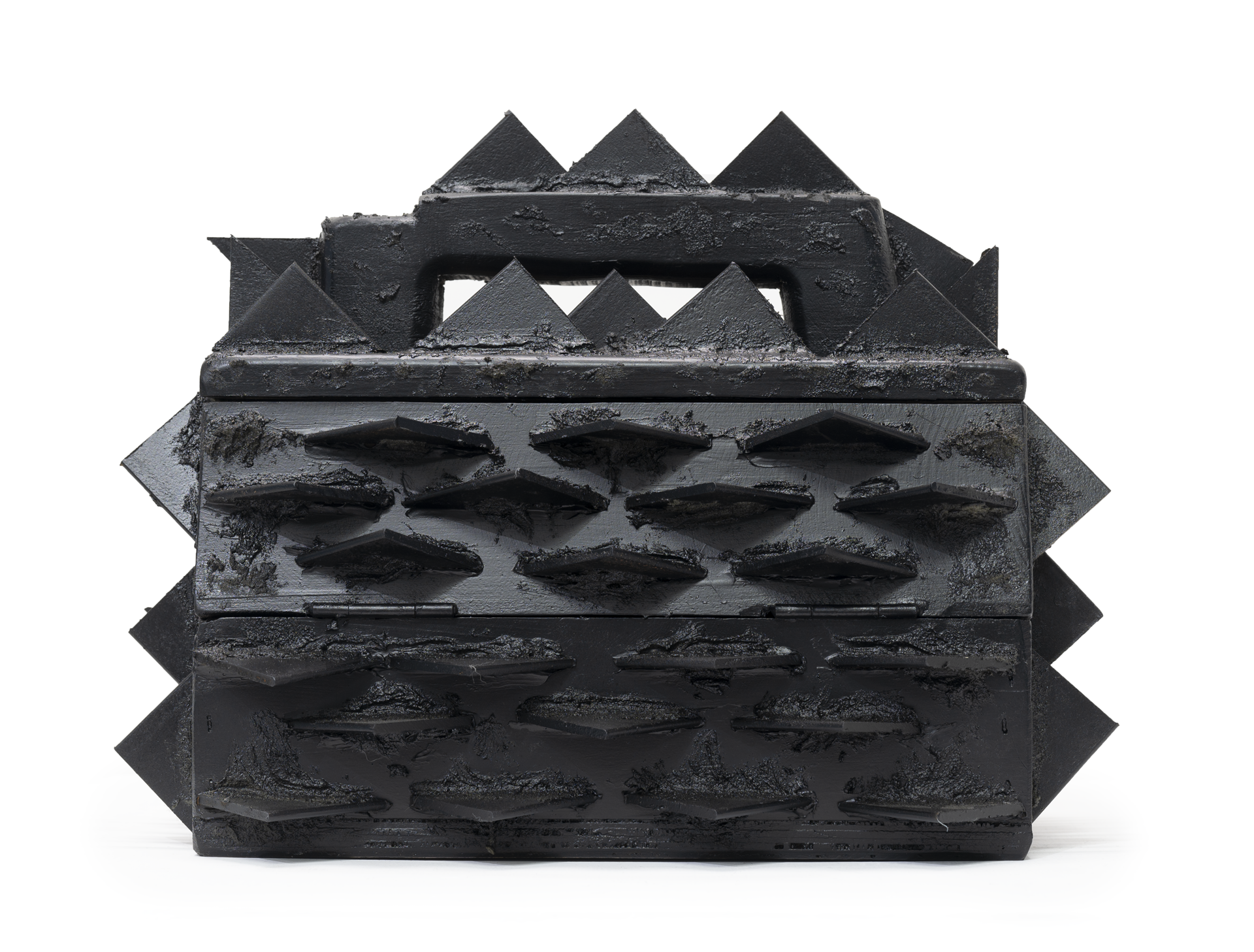
La caja aparece cubierta por esquinas metálicas que, al multiplicarse sobre su superficie, transforman un objeto de trabajo en un cuerpo defensivo. Lo que normalmente sirve para proteger bordes o reforzar estructuras se convierte aquí en una piel de amenaza.
La pieza parte de una reacción corporal: la superficie provoca cautela y obliga a mantener distancia. Esa respuesta es central. La caja de lustre deja de ser únicamente una herramienta de servicio y se convierte en un objeto blindado, hostil y casi orgánico. Su estructura permanece reconocible, pero ya no puede tocarse ni transportarse con facilidad.
Dentro de Máquinas de asignación, esta transformación señala cómo ciertas formas de trabajo, exposición y supervivencia producen sus propias defensas. La máquina heredada no solo asigna determinados cuerpos al servicio; también los obliga a endurecerse para habitar el lugar que les ha sido impuesto. Aquello que protege permite resistir, pero al mismo tiempo dificulta el contacto y convierte la defensa en una condición permanente.
Materiales: caja de lustre de madera intervenida con esquinas metálicas y pintura negra
Dimensiones: pendientes
Pieza única
ENG.
ARMOR
c. 2010
The box is covered with metal corner protectors that, as they multiply across its surface, transform an object of labor into a defensive body. What would normally protect edges or reinforce structures becomes a threatening skin.
The work begins with a bodily reaction: the surface provokes caution and forces the viewer to keep a distance. This response is central. The shoeshine box ceases to be merely a tool of service and becomes an armored, hostile, almost organic object. Its structure remains recognizable, yet it can no longer be touched or carried easily.
Within Machines of Assignment, this transformation points to the ways certain forms of labor, exposure, and survival produce their own defenses. The inherited machine does not only assign certain bodies to service; it also forces them to harden in order to inhabit the position imposed upon them. What offers protection makes resistance possible, but also obstructs contact and turns defense into a permanent condition.
Materials: wooden shoeshine box altered with metal corner protectors and black paint
Dimensions: pending
Unique work
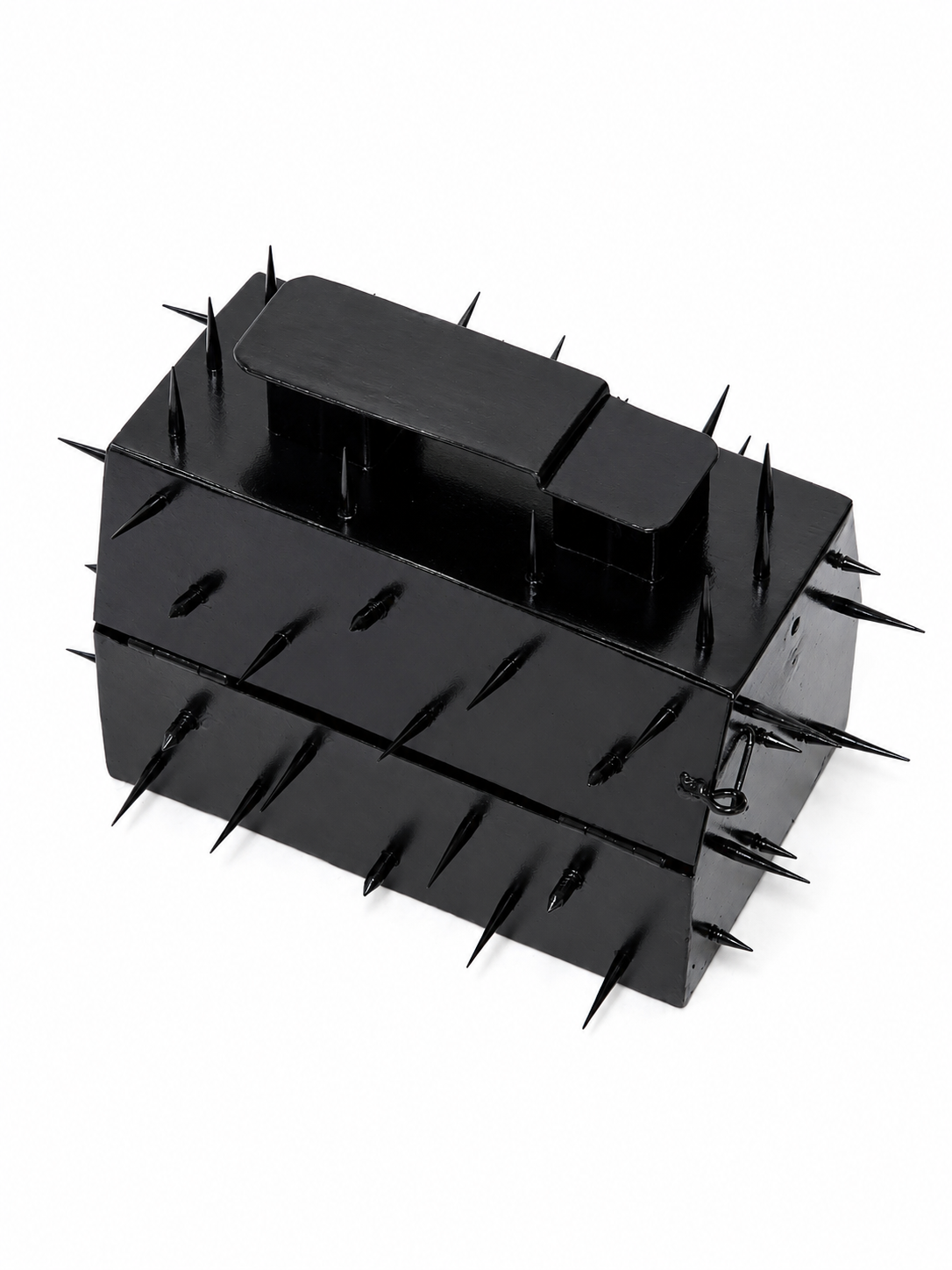
AUTODEFENSA
c. 2009–2010 / re-edición posterior
Esta obra pertenece al cuerpo de trabajo desarrollado a partir de cajas de lustre entendidas como máquinas heredadas. A diferencia de otras piezas de la serie, aquí la caja fue construida en metal y activada mediante picos tomados del lenguaje visual de las chaquetas punk. El objeto asociado al trabajo, al servicio y a la utilidad social se transforma en un cuerpo defensivo, difícil de tocar, pero también en una presencia que busca afirmarse desde la periferia.
La pieza no entiende lo punk únicamente como amenaza. Lo vincula con una actitud de supervivencia, con el “hazlo tú mismo”, con la búsqueda de comunidad y con la posibilidad de construir pertenencia incluso desde el margen. Los picos funcionan como protección y advertencia, pero también como signo de una subjetividad que se niega a permanecer dócil. En esa tensión, la caja deja de ser una herramienta disponible para el uso y se vuelve un objeto cargado de contradicciones: resistencia y fragilidad, deseo de pertenecer y rechazo, aspiración y autodestrucción.
Dentro de mi práctica, esta obra conecta la investigación sobre infancia, clase y servicio con una memoria subcultural propia. La máquina heredada del trabajo se cruza aquí con una energía punk que no promete salvación, pero sí una forma de insistir: endurecerse, inventar comunidad y buscar algo mejor desde un lugar que el sistema ya había colocado al borde.
Materiales: Metal, púas metálicas y pintura negra
Dimensiones: pendientes
Edición / condición: re-edición de una obra original perdida
ENG.
SELF-DEFENSE
c. 2009–2010 / later re-edition
This work belongs to the body of work developed from shoeshine boxes understood as inherited machines. Unlike other pieces in the series, here the box was constructed in metal and activated through spikes taken from the visual language of punk jackets. The object associated with labor, service, and social utility is transformed into a defensive body, difficult to touch, but also into a presence that seeks to assert itself from the margins.
The work does not understand punk solely as a form of threat. It connects it to an attitude of survival, to do-it-yourself practice, to the search for community, and to the possibility of constructing belonging even from the edge. The spikes operate as protection and warning, but also as signs of a subjectivity that refuses to remain docile. Within this tension, the box ceases to be a tool available for use and becomes an object charged with contradictions: resistance and fragility, the desire to belong and rejection, aspiration and self-destruction.
Within my practice, this work connects the investigation into childhood, class, and service with a personal subcultural memory. The inherited machine of labor intersects here with a punk energy that does not promise salvation, but does insist on a way of persisting: to harden oneself, to invent community, and to seek something better from a place the system had already pushed to the margins.
Materials: metal with metal spikes and black paint
Dimensions: pending
Edition / condition: re-edition of a lost original work
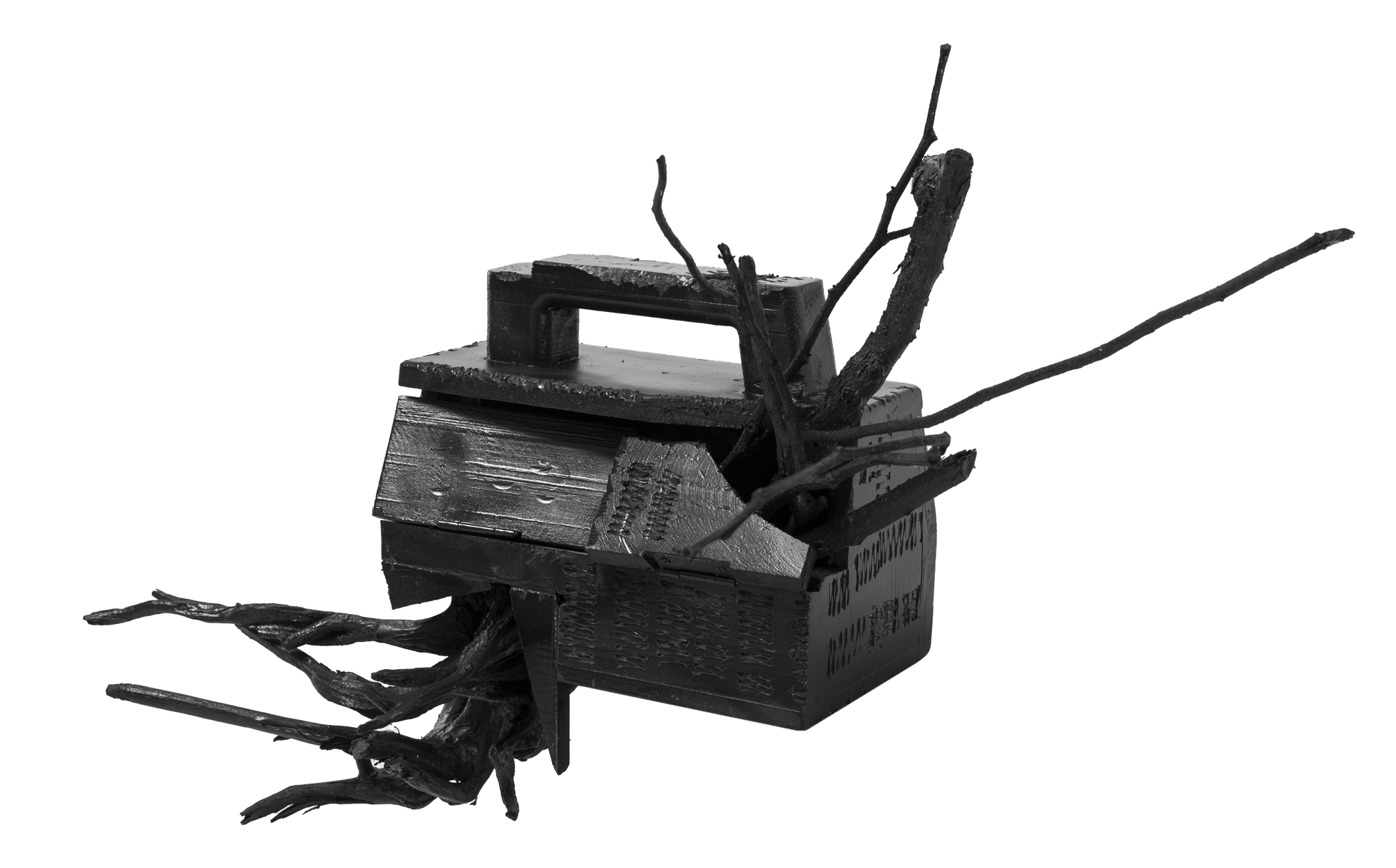
RAÍZ DE SERVICIO
c. 2005
Esta obra pertenece al cuerpo de trabajo desarrollado a partir de cajas de lustre entendidas como máquinas heredadas. Aquí, la caja aparece dañada, calada y atravesada por raíces y ramas muertas. El objeto deja de funcionar como herramienta de trabajo y se convierte en una estructura orgánica interrumpida: algo que parece haber crecido desde la caja, pero que ya no pertenece plenamente a la vida.
La pieza vincula trabajo infantil, herencia social y crecimiento detenido. Las raíces que emergen por debajo no afirman un origen estable, sino una relación fracturada con el suelo; las ramas que se proyectan hacia arriba no prometen expansión, sino una aspiración seca, suspendida. En lugar de representar una infancia específica, la obra observa la máquina que convierte ciertos cuerpos en cuerpos útiles demasiado pronto, afectando no solo lo que hacen, sino también aquello que pueden imaginar como futuro.
Materiales: caja de lustre intervenida con raíces muertas, ramas muertas, cortes y pintura negra
Dimensiones: pendientes
Pieza única
ENG.
ROOT OF SERVICE
c. 2005
This work belongs to the body of work developed from shoeshine boxes understood as inherited machines. Here, the box appears damaged, cut through, and pierced by dead roots and branches. The object ceases to function as a tool of labor and becomes an interrupted organic structure: something that seems to have grown out of the box, yet no longer fully belongs to life.
The work connects child labor, social inheritance, and arrested growth. The roots emerging from below do not affirm a stable origin, but rather a fractured relation to the ground; the branches extending upward do not promise expansion, but a dry, suspended aspiration. Rather than representing a specific childhood, the piece examines the machine that turns certain bodies into useful bodies too early, affecting not only what they do, but also what they are able to imagine as a future.
Materials: shoeshine box altered with dead roots, dead branches, cuts, and black paint
Dimensions: pending
Unique work